Car Vacation Checklist: The Ultimate Pre-Trip Guide
- Tires, brakes, fluids, and lighting are the 4 priority technical points to check one week before departure.
- For an electric vehicle (EV), also verify real-world range, charging plans, and battery health.
- Mandatory documents (registration, insurance, driver’s license) must be up to date and easily accessible.
- Planning your departure outside of peak holiday traffic reduces fatigue and accident risks.
- Preparing a written checklist 5 to 7 days in advance helps prevent last-minute oversights.
Before heading off on vacation, the question isn’t whether you should check your vehicle, but rather what to prioritize and in what order. The answer falls into four main categories: the car’s mechanical condition (tires, brakes, fluids, lighting), administrative documents, safety and comfort equipment for the trip, and—increasingly—specific preparations for electric vehicles (range, charging). Organizing your trip preparation a week before departure, rather than the day before, allows you to identify and fix issues without stress. This is especially important during school holidays, a period when roads are saturated and even the smallest mechanical mishap can quickly turn into a long traffic jam or a lengthy wait for roadside assistance.
Tires: Your First Priority Before a Long Drive
Tires are your car’s only contact point with the road: their condition directly affects braking distance and cornering stability, especially when the vehicle is heavily loaded and driving at high speeds on the highway.
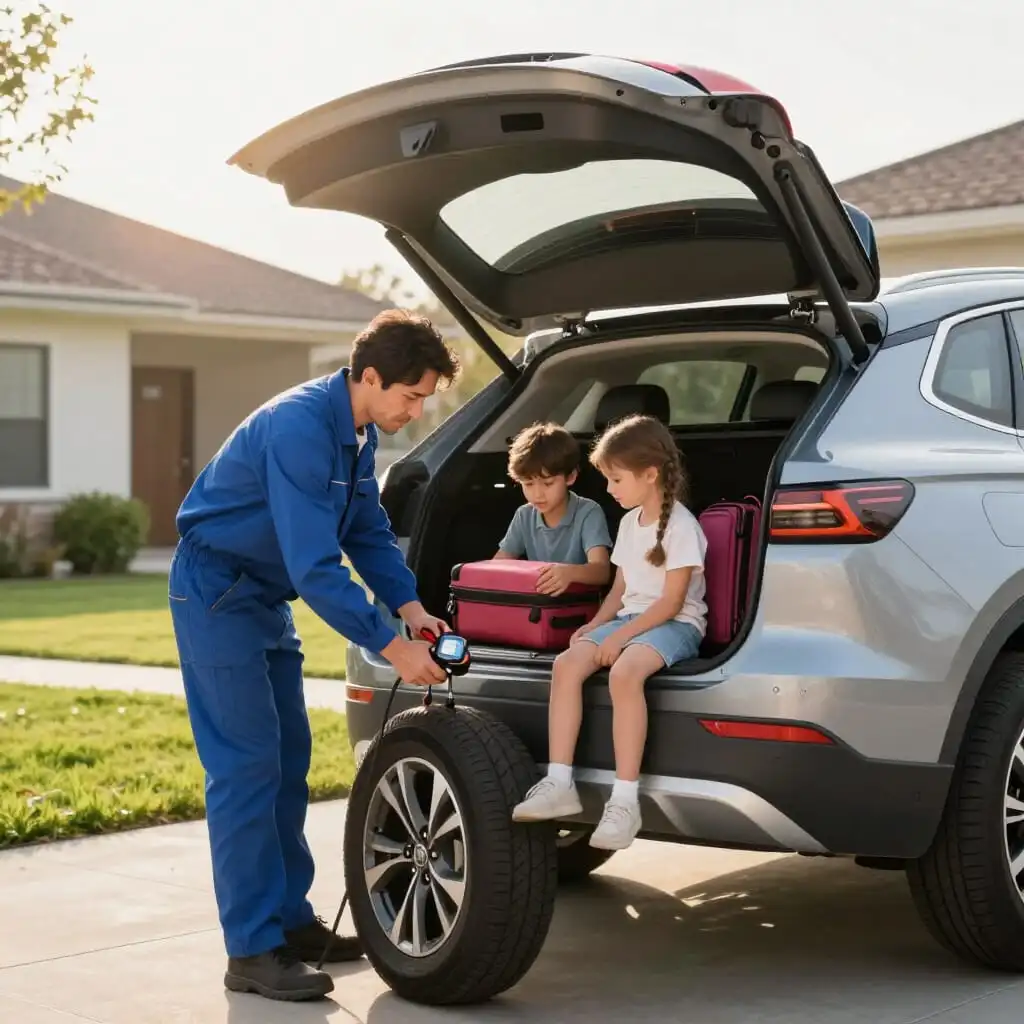
There are three specific things to check. First, tire pressure. Check this while the tires are cold, using the “full load” values found on the sticker inside the fuel flap or on the door pillar—a car loaded for vacation often requires pressure 0.2 to 0.3 bar higher than daily driving levels. Second, tread depth: the legal minimum is 1.6 mm, but grip on wet roads degrades significantly below 3 mm, so replacement is recommended before a long trip rather than after. Finally, perform a visual inspection: look for bulges, cuts, irregular wear (often a sign of alignment issues), and the tire’s age—once a tire is over 10 years old, it loses elasticity and should be replaced, even if it looks unworn.
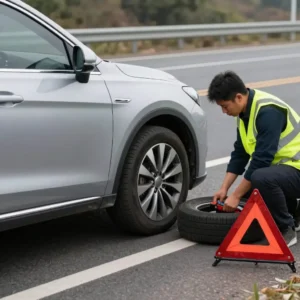
This check should also include your spare tire or puncture repair kit, which often sits forgotten in the trunk for years: a deflated spare is useless when you need it, and many puncture repair sprays have an expiration date. This check takes only ten minutes at a gas station and prevents one of the most common highway breakdown scenarios during the summer season.
Brakes, Fluids, and Lighting: Other Mechanical Essentials
After the tires, three other technical areas deserve special attention before a long trip, especially if the car hasn’t been driven much recently.
The braking system undergoes extra stress during vacations: the car is heavier, sometimes towing a trailer or carrying a roof box, and may be driving through mountainous terrain. Squeaking noises, a pedal that feels unusually soft, or increased braking distances are warning signs that should not be ignored—it is much better to have a garage inspection than to travel with doubts.
Fluid levels should be checked when the engine is cold: engine oil, coolant, brake fluid, and windshield washer fluid. Low oil levels on a long journey can cause premature engine wear or even engine failure in high temperatures. Windshield washer fluid is often neglected but becomes essential within the first few miles of highway driving due to insects and dust.
Finally, test all lighting—low beams, high beams, indicators, brake lights, and tail lights—ideally with the help of a second person. An undetected blown bulb can lead to a fine during a roadside check and, more seriously, poses a real risk of collision at night or in bad weather. These three checks take less than twenty minutes and can be done yourself without specialized mechanical skills.
Mandatory Documents and Essential Safety Equipment
Beyond mechanics, organizing your road trip involves simple administrative checks that are easy to forget under the pressure of departure.
Regarding paperwork: ensure you have your vehicle registration, driver’s license, proof of insurance, and, if traveling abroad, an international driving permit or equivalent documents required by your destination. Also, verify the validity of your vehicle inspection—an expired inspection can cause major issues in the event of an accident or a roadside stop. These documents should be stored in an accessible place, not buried at the bottom of your trunk.
Regarding equipment, safety regulations require a high-visibility vest and a warning triangle; these should be kept in the passenger cabin rather than the trunk (in the event of a breakdown, exiting the vehicle without a vest before reaching it is dangerous). It is also highly recommended to carry a first-aid kit, a phone charger, water, and entertainment for children—a trip extended by holiday traffic jams is much more manageable when you are prepared for a few extra hours.
One often-forgotten tip: inform your insurer or check your policy if your trip includes another country, and save your roadside assistance number in your phone rather than relying on a search during a breakdown.
Preparing an Electric Vehicle for a Road Trip
Preparing an electric vehicle (EV) requires two additional checks that aren’t necessary for combustion engines: real-world range and charging planning.
The range displayed by the manufacturer is calculated under optimal conditions, which rarely reflect a loaded summer trip with air conditioning running at highway speeds. In practice, real-world highway range can be 20% to 30% lower than the advertised figure—an offset you must factor into your charging stop calculations rather than discovering mid-journey.
Before leaving, it is useful to plan your charging stops along your route, identifying two or three fast-charging stations compatible with your vehicle in advance, with a safety margin in case a station is out of service—a common occurrence on busy routes during holiday periods. Dedicated apps allow you to check real-time charger availability before every stop.
Regarding the vehicle itself, the 12V auxiliary battery (which powers standard equipment like lights) deserves the same check as in a combustion car. Similarly, check your tires, as wear can sometimes be faster on EVs due to the extra weight from the battery. Finally, starting with a charge of 80-90% rather than 100% can help preserve long-term battery health while still providing enough range for your first leg.
Choosing the Best Departure Time During Holiday Peaks
Vacation preparation isn’t just about the vehicle; the day and time you choose to leave directly affects driver fatigue and accident risk.
During peak holiday travel periods, traffic spikes are concentrated during specific windows: Saturday mornings between 8:00 AM and 1:00 PM for those heading away, and Sunday afternoons for those returning, are statistically the busiest times on major highways. Shifting your departure to a Friday evening, very early Sunday morning, or avoiding Saturday altogether can often cut your travel time in half on the most congested routes.
Fatigue remains a major risk factor on long summer trips: a fifteen-minute break every two hours is recommended. Avoid driving immediately after a heavy meal or during the hottest parts of the day if your car is not air-conditioned. Checking weather forecasts and traffic alerts the day before you leave is the final piece of the puzzle, especially for trips through mountainous areas or regions prone to summer storms.
Finally, always inform a loved one of your itinerary and estimated arrival time—a simple precaution that is incredibly helpful if you break down in an area with poor mobile coverage.
When should I start checking my car before a vacation?
Ideally one week before departure, to allow enough time to repair any detected issues (tires, brakes, bulbs) without a last-minute rush.
What tire pressure should I use for a heavily loaded car?
Refer to the “full load” rating on the sticker in your fuel flap or on the door pillar; this is typically 0.2 to 0.3 bar higher than standard pressure.
Should I charge an electric vehicle to 100% before a long trip?
No, a charge of 80-90% is usually sufficient for the first leg and better preserves long-term battery health.
What is the best time to leave to avoid holiday traffic jams?
Avoid Saturday mornings when heading away and Sunday afternoons when returning; leaving on a Friday evening or very early Sunday morning minimizes travel time.
Which administrative documents should I check before driving?
Vehicle registration, driver’s license, proof of insurance, valid vehicle inspection, and, if traveling abroad, the required international documents.
What safety equipment is mandatory on board?
A high-visibility vest and a warning triangle, which should be kept in the cabin rather than the trunk for easy access.
Sources
- Auto: Checks to perform before going on vacation – Lesfurets
- The 10 things to check on your car before hitting the road – Caroom
- 6 essential checks to perform on your car before leaving – Tictactrip
- Long trip car checklist: the indispensables to check – Gueudet

À découvrir

Check Engine Light On: What to Do? Complete Guide
Check engine light orange or red? Learn what to do based on color and symptoms, and how to diagnose the problem.

How to Store Tires Correctly | Complete Guide
November 5, 2026
Tire Lifespan: Miles, Years, and Wear Signs
November 6, 2026