What to do in case of a flat tire? The complete guide (car, bike, motorcycle)
- In a car, slow down gradually without braking abruptly and pull over to a safe, flat area.
- A sidewall puncture is almost never repairable, unlike a puncture on the tread.
- Repairing a tube or a tubeless tire costs a few dollars with a kit, compared to $60–$220 for a professional replacement.
- Auto insurance usually only covers punctures through specific coverage (“tire damage” or roadside assistance), which is rarely included in basic policies.
- For tubeless road or mountain bikes, a sealant spray or a plug kit can often get you moving again in minutes.
A flat tire is handled differently depending on whether it happens to a car traveling at 70 mph, a bike out on a long ride, or an electric scooter on a city street. The first reflex is always the same: slow down without panicking, avoid any sudden braking, and move away from traffic before assessing the damage. From there, everything depends on where the puncture is located, the type of tire (tubed or tubeless), and the equipment you have on hand. This guide details the steps to take for each vehicle, which repairs are possible, estimated costs, and what insurance actually covers.
Flat tires in a car: essential safety steps
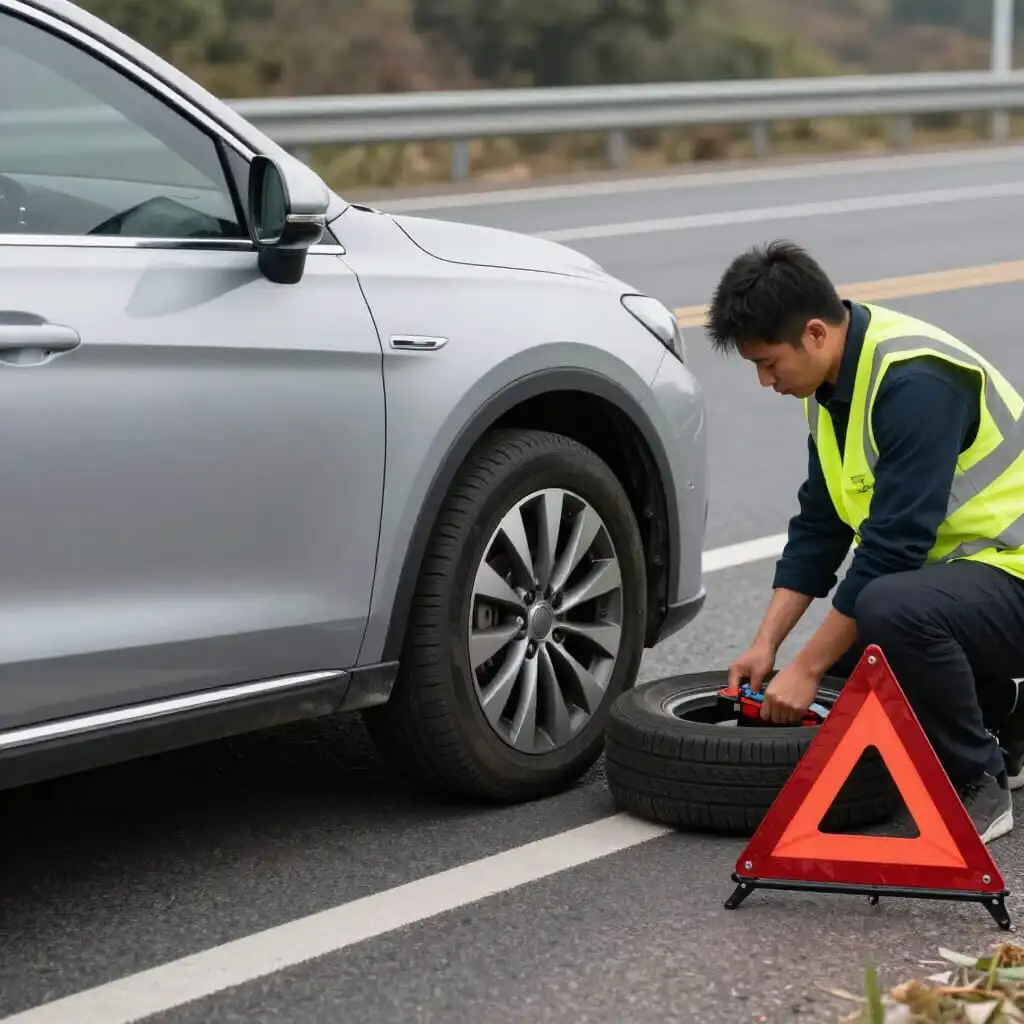
As soon as a tire loses pressure while driving, the car will pull to one side and the steering will feel heavier. Never brake abruptly: ease off the accelerator, let your speed drop naturally, and steer smoothly toward the emergency shoulder or a flat area away from traffic.
Once stopped, turn on your hazard lights and exit the vehicle on the side away from traffic, wearing a reflective safety vest. Place your warning triangle about 30 yards behind the vehicle if you are on a highway. Next, inspect the tire: a nail or screw embedded in the tread usually allows you to drive cautiously to a garage, whereas a completely flat or unseated tire requires changing the wheel on the spot or calling for roadside assistance.
Most modern cars no longer come with a spare tire, but instead include a tire repair kit (sealant + compressor) or run-flat tires, which allow you to drive at reduced speeds (max 50 mph, for about 50 miles) to the nearest service center. Check for this equipment in your trunk before any long trip, especially in summer when high temperatures increase the risk of punctures due to rubber overheating.
Repair or replace: it depends on the location
Not all flat tires can be repaired. The rule generally accepted by professionals distinguishes three zones on the tire: the central tread, the shoulders, and the sidewall.
A puncture located in the tread, with a diameter of less than 6mm, is generally repairable using a plug-patch combo from the inside, provided the tire has not been driven on while flat for a long time (which irreparably damages the carcass). On the other hand, a sidewall puncture affects an area that is constantly flexing; repair is almost systematically refused by mechanics because the risk of a later blowout is too high. In this case, replacing the tire is the only safe option.
A professional will always remove the tire to inspect the inside of the carcass before making a decision, as prolonged deflation can cause damage that is invisible from the outside. A tire repaired correctly following industry standards (a plug + internal patch, not just a simple external plug) will regain its airtight seal and road legality.
Bike, MTB, and electric scooter punctures: roadside repairs
On a standard bike equipped with an inner tube, the most frequent issue is a pinch flat or a puncture caused by a sharp object in the rear wheel, which often takes more strain. To repair a rear bike tire puncture, you need to remove the wheel, use tire levers to pry one side of the tire off, remove the tube, find the hole (often by inflating it slightly and submerging it in water), apply a patch with specific glue, or simply replace the tube—which is the fastest solution during a ride.
For e-bike punctures, the process is identical regarding the tire, but be careful with the motor cable often integrated into the rear wheel: it is best to consult your manual before disassembly if you are not comfortable, as some models require disconnecting the motor connector.
With tubeless MTB tires, the sealant inside the tire often plugs small punctures automatically as you ride. For larger holes, a rubber plug inserted using a dedicated tool (a tire plug tool) is usually enough to get you moving again in less than five minutes without even removing the wheel.
Electric scooter punctures present a different challenge: many models use solid tires or inner tubes that are difficult to access without specific tools. A roadside tire sealant spray may suffice until you can reach a specialized repair shop, as most standard bike shops do not service these types of tires.
Costs of tire repair or replacement
Costs vary significantly depending on the vehicle and the chosen solution. For a bike, a patch costs cents and a complete repair kit costs a few dollars; a new inner tube is around $5 to $10. At a bike shop, a repair including labor generally stays under $15–$25.
For a car, repairing a tire (plug + internal patch) costs on average between $15 and $35 at an auto center or garage, compared to a full replacement which varies from $60 to over $220 depending on the size, brand, and tire range. The price of a car tire puncture increases further if it occurs on a tire with very little tread left, sometimes forcing you to replace both tires on the axle to maintain even wear (a common professional recommendation).
For an inflatable boat, repairing a puncture involves applying a patch specific to the material of the tube (Hypalon or PVC depending on the model), using compatible glue, and allowing a long drying time (24 to 48 hours) before returning to the water—this is an operation not to be confused with car or bike kits, as glues are not interchangeable between materials.
Punctures and insurance: what is actually covered
Contrary to popular belief, basic auto insurance (liability or comprehensive) does not automatically cover punctures. This type of incident usually falls under an optional coverage, often called “tire damage” or included in a roadside assistance package, which must be specifically selected when signing the contract or as an annual add-on.
When available, this coverage pays for the replacement of the damaged tire, sometimes subject to a deductible, and may include roadside assistance or towing to a garage if the vehicle is immobilized. It is therefore essential to check your policy’s terms and conditions before you need them: some insurers limit coverage to punctures caused by a third party (vandalism, debris on the road) and exclude normal tire wear.
For a bicycle or electric scooter, homeowners’ insurance or a dedicated theft/damage warranty for bikes may sometimes cover a puncture caused by vandalism, but rarely covers wear and tear. In practice, most cyclists handle these minor issues themselves without filing an insurance claim, as the repair cost is usually lower than the deductible.
Can I drive with a flat tire to the garage?
It depends on how much air is left. If the tire still holds some pressure, drive slowly and cautiously over a short distance. If it is completely flat, it is better not to drive on it to avoid damaging the carcass; change the wheel on the spot or call for assistance.
What is the difference between a “flat” and a “puncture”?
A “flat” usually refers to a tire that has lost air for any reason, while a “puncture” specifically refers to a hole caused by an object piercing the rubber.
Can a tubeless tire be repaired by myself?
Yes, in most cases. The sealant plugs small holes automatically, and a rubber plug inserted with a dedicated tool is sufficient for larger punctures without removing the wheel.
How long does a car tire repair take at a shop?
Generally, expect between 20 and 40 minutes for removal, carcass inspection, and a plug-patch repair, not including waiting time depending on how busy the shop is.
Why is a sidewall puncture not repairable?
The sidewall is constantly flexing with every rotation of the wheel. Repairing it weakens the structure long-term and significantly increases the risk of a blowout, which is why professionals almost always insist on replacement.
Should I change both tires on the same axle after a puncture?
It is not mandatory, but recommended if the wear difference between the two tires is significant, in order to preserve differential balance and handling, especially on all-wheel-drive vehicles.
Sources
- Centrale Pneus – Tire Punctures
- Pneus-Online – Flat Tire: Repair or Replacement
- ALLOPNEUS – Flat Tires and Insurance
- Meilleurtaux – Flat Tires and Auto Insurance

À découvrir
Tire Pressure Guide: How Much to Inflate?
Find the ideal tire pressure for your vehicle. Tips for cars, bikes, MTBs, and trailers. Learn how to check your pressure while cold.
How to Check Tire Pressure? A Complete Guide
November 3, 2026
What Does the DOT Code on a Tire Mean? Full Guide
November 6, 2026