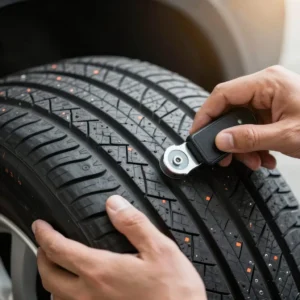

How to Choose the Right Tire Size? The Complete Guide
- Car tire size is read directly on the sidewall in the format: width/aspect ratio R diameter (e.g., 205/55 R16)
- Each number has a precise meaning: width in mm, aspect ratio as a % of width, and rim diameter in inches
- Your vehicle registration document (check the vehicle details section) is a reliable way to find your car tire size without error
- Load and speed indices are often overlooked but are just as important as the dimensions themselves
- Bicycles (road, MTB) and microcars follow different measurement logics and should not be confused with car tires
Choosing the right tire size begins with knowing how to read the series of numbers and letters on the sidewall of your current tire—for example, 205/55 R16 91V. This sequence specifies the width in millimeters, the sidewall height as a percentage of the width, the rim diameter in inches, and finally the load and speed indices. To avoid mistakes, rely on three reliable sources: your current tires, your vehicle registration document, or the manufacturer’s manual. This guide details every step to find, understand, and choose the correct tire size for a car, motorcycle, or bicycle, without risking improper installation.
Reading Car Tire Size: What Does Each Number Mean?
Car tire size meanings are based on a standardized marking used by all manufacturers. Let’s take the example 205/55 R16 91V: the 205 corresponds to the tire width in millimeters, measured from sidewall to sidewall. The 55 is the aspect ratio, expressed as a percentage of that width—in this case, the sidewall height is 55% of 205 mm, which is approximately 113 mm. The letter R indicates a “radial” structure, which is the near-universal construction for modern tires. The 16 indicates the rim diameter in inches, a value that must match your rim exactly, with no margin for error.
Next come the load index (91) and the speed rating (V). The load index is found in a correspondence table: 91 corresponds to a maximum load of approximately 615 kg per tire. The speed rating indicates the maximum speed the tire can support at its maximum load—V corresponds to 240 km/h. Fitting a tire with a lower index than the original is prohibited and dangerous, even if the car never reaches those speeds: the index also reflects the structural strength of the tire, not just its top speed.
On some tires, you may also find a specific car tire valve diameter depending on the rim type (steel, alloy, or integrated TPMS). While this detail is mainly for professional installers, it explains why a standard valve might not always work during a replacement, especially on vehicles equipped with tire pressure sensors.
Where to Find Your Car’s Tire Size?
There are three error-free methods to find your car tire size. The first and simplest is to read the sidewall of the mounted tire, provided it is the original size or meets manufacturer recommendations. The second is to check the sticker located on the driver’s door jamb or the fuel filler flap, which sometimes lists several approved dimensions depending on the specific model version.
The third method, and the most reliable if you are in doubt, is to check your vehicle registration document. On most registration papers, the vehicle type and variant sections can be cross-referenced with the manufacturer’s technical specifications to obtain the exact dimension. This approach is particularly useful after changing rims or when buying a used vehicle with an unknown tire history.
There are also online tools to find tire size by license plate, which query a database using your vehicle’s plate number. This is convenient but should always be cross-referenced with your registration or the tire sidewall, as these databases do not always cover specific versions or optional equipment (such as larger optional rims).
If you are still unsure, a tire professional can verify compatibility in minutes using your license plate number or the Vehicle Identification Number (VIN), which is engraved on the chassis and listed on your registration.
Can You Change Tire Dimensions?
Changing your car tire size is possible, but only within strict limits set by the manufacturer and regulations. The golden rule: the overall tire diameter must remain almost identical (a tolerance of around 3% is generally accepted); otherwise, you risk distorting the speedometer, ABS, ESP, and ground clearance. A wider dimension with a lower profile (for example, moving from 205/55 R16 to 225/45 R17) is a common practice known as “plus-sizing,” provided you verify compatibility with the wheel arches and vehicle homologation.
Modifying dimensions without respecting these constraints can lead to a failed vehicle inspection or even non-compliance issues with your insurance in the event of an accident. Vehicle inspection reports specifically check for consistency between the mounted dimensions and those indicated on the registration or manufacturer’s spec sheet.
For microcars, the logic is different: these light vehicles use specific microcar tire sizes, often around 145/70 R13 or 155/70 R13, adapted to a lower weight and a speed limit of 45 km/h. You should never try to apply standard car tire dimensions to these vehicles, nor vice versa, as the load and speed indices are not comparable.
Car Tire Size Chart: Understanding Equivalents
A car tire size chart allows you to quickly visualize compatible sizes that maintain an equivalent overall diameter. Here are some common equivalents used when changing rims:
- 195/65 R15 is roughly equivalent to 205/60 R15 or 185/65 R15
- 205/55 R16 is roughly equivalent to 225/45 R17 or 195/60 R16
- 215/60 R16 is roughly equivalent to 205/65 R16 or 225/55 R16
This type of car tire size correspondence never replaces the need to check the permitted load and speed ratings: two dimensions with the same diameter may have different indices. Car tire width directly affects lateral grip and rolling resistance, while the aspect ratio affects comfort and rim protection against impacts. A low profile (40 or 45 profile) improves handling precision but transmits more road irregularities; a higher profile (60 or 65 profile) provides better cushioning but may reduce cornering responsiveness.
To get a reliable car tire measurement before buying, a caliper or a measuring tape is sufficient to check the actual width of the mounted tire, especially on a used vehicle where the original sticker may have faded.
Choosing Tire Sizes for Road Bikes, MTBs, and Microcars
The logic for choosing road bike or MTB tire sizes is completely different from that of a car. On a bicycle, the dimension is read in inches (e.g., 700x25c for road, 29×2.3 for MTB) or sometimes in millimeters according to the ETRTO standard, which is also engraved on the sidewall. The first number indicates the wheel diameter, and the second indicates the tire width.
To choose the right road bike tire size, the width (23, 25, or 28 mm) depends primarily on the desired comfort and the type of road: a wider tire reduces the required pressure and improves grip on degraded surfaces without significantly sacrificing speed, contrary to a long-held myth among road cyclists. To choose an MTB tire size, the width generally ranges between 2.1 and 2.6 inches depending on the discipline: cross-country, all-mountain, or downhill, representing a compromise between weight and traction.
Finding your bike tire size is done directly on the old tire or on the rim itself, where the ETRTO diameter is often engraved. If in doubt, a bike specialist can verify compatibility in seconds using the internal diameter of the tire, expressed in millimeters according to the ETRTO standard, which is more reliable than sometimes ambiguous commercial names (a “26 inch” tire doesn’t always correspond to the same actual diameter depending on the brand).
How do I read a tire dimension on the sidewall?
The dimension is displayed as width/aspect ratio R diameter, followed by the load and speed indices—for example, 205/55 R16 91V, where 205 is the width in mm, 55 is the aspect ratio percentage, and 16 is the rim diameter in inches.
Where can I find the tire size on my vehicle registration?
The vehicle type and variant sections of your registration document can be cross-referenced with the manufacturer’s technical data to determine the approved tire dimension.
Can I fit a different tire size than the original?
Yes, within a tolerance of approximately 3% in overall diameter, to avoid affecting the speedometer or electronic aids like ABS or ESP.
What tire size is used for a microcar?
Microcars use specific dimensions such as 145/70 R13 or 155/70 R13, adapted to their low weight and 45 km/h speed limit.
How do I choose the right tire size for a road bike or MTB?
For road bikes, width (23 to 28 mm) is chosen based on desired comfort; for MTBs, it varies from 2.1 to 2.6 inches depending on the riding style. The ETRTO diameter engraved on the sidewall ensures rim compatibility.
Does the valve diameter depend on the tire size?
No, the car tire valve diameter depends mainly on the rim type and the presence of tire pressure sensors (TPMS), not directly on the tire dimension itself.
Sources
- What tire size for my vehicle? — ALLOPNEUS
- Tire dimensions — Toutcalculer.com
- Tire markings explained — Michelin

À découvrir
How to Store Tires Correctly | Complete Guide
Learn how to store your tires correctly: ideal conditions, cleaning tips, and preservation. Avoid mistakes that damage your tires.

How to Choose Tires? Complete Guide by Usage
November 4, 2026
Tire Pressure Guide: How Much to Inflate?
November 4, 2026