
How to Tell if Your Tires Are Worn? Complete 2026 Guide
- The minimum legal limit is 1.6 mm of tread depth across the entire tread area.
- The Tread Wear Indicator (TWI)—a small bump inside the grooves—becomes flush with the surface when the tire reaches this limit.
- The “coin test” allows for a quick check without tools, though it is less precise than a dedicated tread depth gauge.
- Irregular wear (inner, outer, center, or cupping) indicates alignment or pressure issues, not just tire age.
- Driving with tires below the legal limit can result in fines and penalty points on your license.
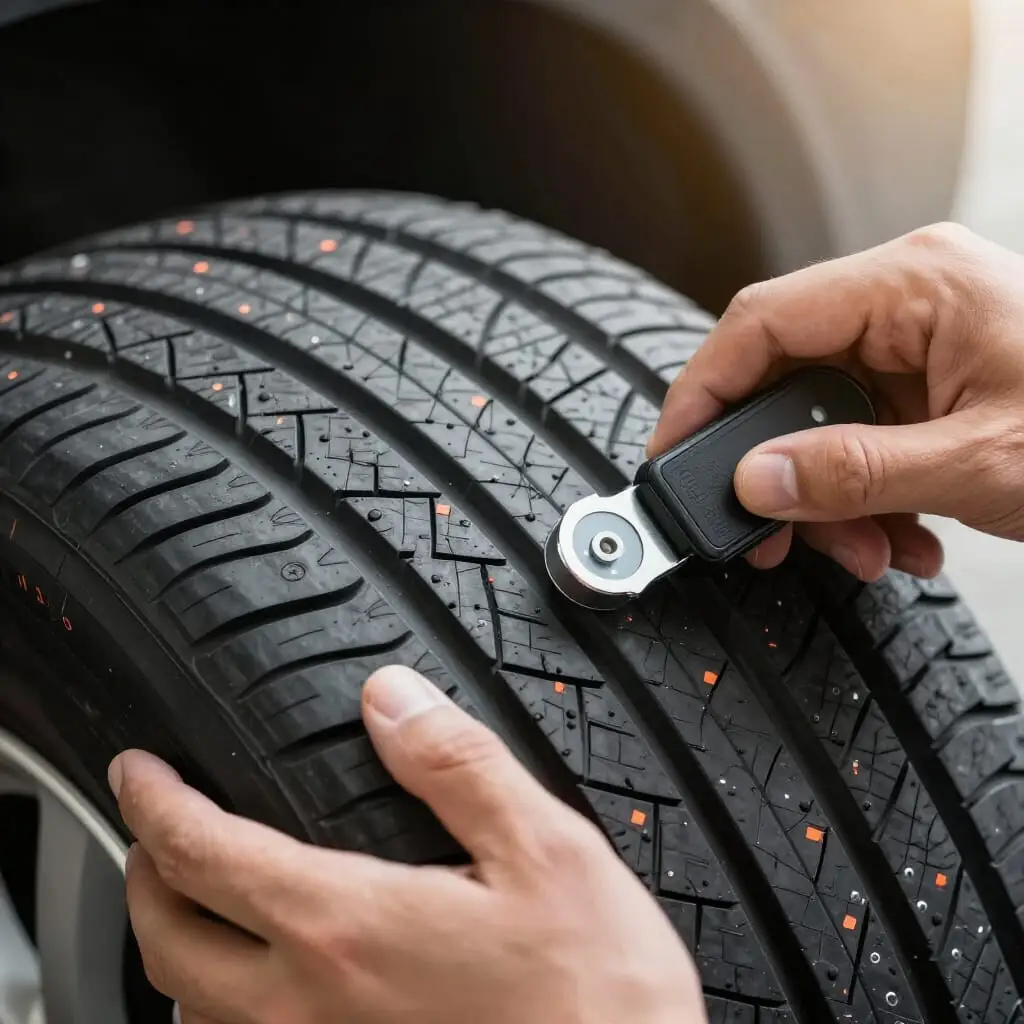
You can identify a worn tire in just a few seconds: simply check the depth of the grooves and compare the tread to the Tread Wear Indicator (TWI) molded into the tire—a small rubber bridge located at the bottom of the main grooves. As soon as the tread surface reaches the level of this indicator, the depth has hit 1.6 mm, the legal limit below which the tire must be replaced. However, wear is not always even: a tire may look fine in the center but be nearly smooth on the inside or outside, signaling a problem with pressure, alignment, or suspension. This guide details how to check your tires, the types of wear to watch for, and the risks involved for both cars and motorcycles.
The Tread Wear Indicator: The Official Built-in Gauge
All road-legal tires, for both cars and motorcycles, feature a Tread Wear Indicator (TWI) molded directly into the rubber at the bottom of the main tread grooves. These are small raised bumps, usually six to eight distributed around the entire circumference, which sit flush with the tread surface when the depth reaches exactly 1.6 mm—the legal limit in most regions.
To find them, look for a small triangle ▲ or the letters “TWI” (Tread Wear Indicator) embossed on the tire sidewall near the edge of the tread. This mark indicates the exact location of the nearest indicator within the groove. Simply compare the height of the tread around this point to the height of the indicator: if they are level, your tires need immediate replacement.
The advantage of this method is that it requires no tools and works for both a quick check at a gas station or a thorough inspection before a long trip. However, it has one limitation: it only tells you about the wear at that specific point, not whether the wear is uniform across the entire width of the tire—a crucial factor in detecting mechanical issues.
The Coin Test: A Simple and Reliable Method
If you don’t have a tread depth gauge on hand, a coin is the most common trick to evaluate tire wear. By using a coin with a distinct rim or edge, you can create a quick reference point near the 1.6 mm legal threshold.
The principle is simple: insert the coin into a main groove with the edge facing down. If the distinctive rim or a portion of the coin’s design is hidden deep within the groove, your tread depth is likely still sufficient (generally above 2 mm). If part of the rim remains clearly visible above the rubber, it means the tire is approaching or has exceeded the legal limit and should be replaced soon.
Keep in mind that this method is indicative: it provides an estimate rather than a measurement accurate to a tenth of a millimeter like a dedicated tread depth gauge, which is inexpensive and easy to keep in your glovebox. For a serious check before a vehicle inspection or a long journey, it is better to measure multiple points across the width of the tire rather than relying on a single test in the center.
Inner, Outer, or Center Wear: What It Reveals
Uniform wear across the entire width of the tire is normal and represents the natural aging of the rubber over many miles. However, when wear is concentrated on one side or in the center, it signals a mechanical malfunction that must be corrected before replacing the tires; otherwise, you will simply repeat the problem with the new set.
Inner tire wear most often indicates excessive negative camber or improper alignment, frequently caused by hitting a curb or a deep pothole. Outer tire wear generally points to positive camber or aggressive driving habits involving heavy cornering. Wear concentrated in the center of the tread (a smoother middle strip) almost always indicates chronic over-inflation, while wear on both outer edges with a healthy center suggests under-inflation.
“Cupping” or scalloped wear—where smooth patches alternate with deeper sections around the circumference—is usually caused by wheel imbalance or suspension issues (such as worn shock absorbers or ball joints). Combined inner and outer wear with a preserved center almost always confirms prolonged low tire pressure. In all cases, having your alignment checked by a professional is essential to identify the cause before installing new tires.
Wear and Vehicle Inspections: What the Regulations Say
During a vehicle inspection, tread depth is systematically checked at several points on each tire. The regulatory threshold remains fixed at 1.6 mm across the tread, typically measured at three-quarters of the usable width of the tread.
A tire deemed too worn will result in a mandatory re-inspection: the vehicle must pass the check again within a set period (usually two months) after the tires have been replaced. Inspectors also check for bulges, deep cuts, or sidewall deformations, which can lead to a failure even if the tread depth is still within legal limits.
Driving with worn tires on public roads can expose you to significant fines and the loss of driver’s license points. In the event of an accident, insurance companies may also cite the condition of the tires to limit or deny compensation if the wear is deemed a contributing factor to the loss of vehicle control.
Special Cases: All-Season Tires, EVs, and Motorcycles
All-season tires generally wear faster during summer months because their rubber compound is designed to stay softer to maintain flexibility in cold weather. Conversely, they save you the hassle of seasonal tire changes. Their tread wear indicators work exactly like standard tires, but you should also monitor specific snow-performance indicators, often marked by a second indicator or the 3PMSF symbol on the sidewall.
On electric vehicles (EVs), the extra weight of the batteries and the instant torque from electric motors significantly accelerate wear, especially on the front tires during hard acceleration. It is not uncommon for EV tires to wear 20% to 30% faster than those on internal combustion engine vehicles, justifying more frequent monitoring—ideally on a monthly basis.
For motorcycles, wear follows a different logic: the rear tire, which transfers power to the ground, generally wears faster than the front, especially with sporty riding. A “triangular” or “squared-off” shape on the rear tire often indicates mostly straight-line riding with little leaning, whereas excessive wear on the shoulders (sides) relative to the center indicates a riding style focused on cornering. Motorcycle tread wear indicators work on the same principle as car tires, but the safety margin is slimmer due to the smaller contact patch with the road.
At how many mm is a tire considered worn?
The legal limit is 1.6 mm of tread depth. Below this, the tire must be replaced, and a re-inspection is required during vehicle checks.
How can I tell if a tire is worn without a gauge?
The coin test is a great alternative: if the rim of a coin remains visible in the groove, the tire is likely approaching or has exceeded the legal limit.
Why is my tire wearing more on the inside than the outside?
Marked inner wear usually indicates an alignment or camber problem, which should be checked during a professional geometry inspection.
What is the fine for driving with worn tires?
Fines can be significant and may include the loss of penalty points on your driver’s license during a roadside check.
Is motorcycle tire wear checked the same way as a car?
Yes, the tread wear indicator principle is the same, but the rear tire typically wears faster, and the safety margin is smaller.
How many kilometers before a tire is worn out?
This varies greatly depending on driving style and tire type, but a well-maintained tire generally lasts between 30,000 and 50,000 km.
Sources
- How to tell if my tires are worn: a quick method — Pièces et Pneus
- Tire wear: Understand, evaluate, and prevent — Allopneus
- How to interpret a tire’s tread wear indicator — Michelin

À découvrir
How to Check Tire Pressure? A Complete Guide
Learn how to check your tire pressure easily with our complete guide. Expert tips for optimal safety and tire longevity.

Flat Tire Guide: What to Do for Cars, Bikes & Motorcycles
November 3, 2026
When to Change Tires? Complete Guide 2026
November 2, 2026