How to Check Tire Pressure? A Complete Guide
- Check pressure ideally when cold, meaning the tires haven’t been driven for at least 3 hours or for less than 2 km
- Recommended check at least once a month, and before every long trip
- Recommended pressure is found on the driver-side door jamb sticker or in the owner’s manual, never on the tire sidewall
- Checking pressure at a gas station while tires are hot skews the reading: add 0.2 to 0.3 bar to compensate
- An underinflated tire (by 20%) wears out up to twice as fast and increases the risk of a blowout
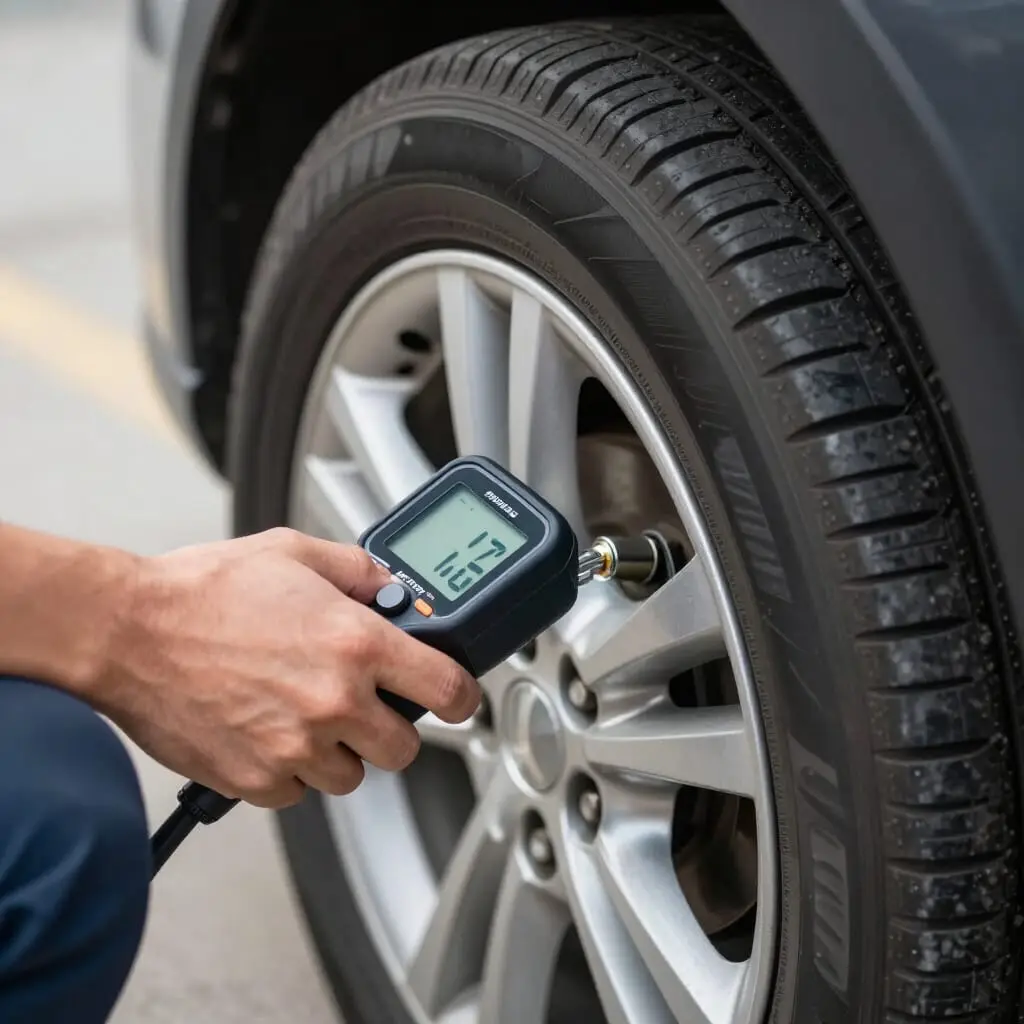
Checking your tire pressure takes less than five minutes using a pressure gauge, a gas station air compressor, or a mobile app linked to an integrated TPMS sensor. The principle is simple: unscrew the valve cap, press the nozzle onto the valve, read the displayed value, and compare it to the manufacturer’s recommended pressure found on the sticker inside the driver-side door. The difficulty isn’t the action itself, but the conditions: cold vs. hot, frequency, which tool to use, and where to find a reliable pump. This guide details every step for a proper check, whether for a city car, a trailer, a bicycle, or a motorcycle.
Cold vs. Hot Tire Pressure: The Rule That Changes Everything
This question comes up constantly, and the answer is unambiguous: tire pressure should be measured when cold. This means the vehicle has not been driven for at least three hours, or has been driven for less than two kilometers at moderate speeds. Driving heats up the air inside the tire, causing it to expand and increasing the measured pressure by 0.2 to 0.3 bar above its actual cold value. A tire showing 2.5 bar when hot might actually only be at 2.2 bar once cooled, resulting in silent underinflation.
Practically, this presents a challenge: the nearest gas station is often where you stop after driving several kilometers, meaning the tires are hot. There are two solutions. First, check the pressure before starting your journey using a portable gauge kept in the glove box. Second, accept the hot measurement at the gas station but adjust your target value: aim for the recommended pressure plus 0.2 to 0.3 bar. Many drivers check their tire pressure while hot without realizing it, which explains many of the discrepancies between the displayed pressure and the actual pressure of the vehicle.
Where and How to Check Tire Pressure in Practice
To check your tire pressure near home, motorists have three options: a gas station equipped with a compressor (often free or costing a few cents), a manual gauge to screw onto the valve, or a portable electric compressor that plugs into the vehicle’s 12V outlet. A pressure gauge remains the most reliable and affordable tool, providing sufficient accuracy for everyday use.
The gas station method always follows the same process: park near the station, unscrew all four valve caps, set the target pressure on the machine (some modern stations display the current reading and allow you to adjust it up or down), press the nozzle firmly onto each valve until the air hissing stops, then read the value or wait for automatic inflation to finish. Remember to check the pressure and reset the tire pressure warning light if your vehicle is equipped with one: on most recent models, this is done via a dashboard menu or a dedicated button, usually after the check rather than before; otherwise, the system will continue to display an outdated alert. Don’t forget the spare tire if your vehicle has one—it’s often neglected, even though it must also maintain a specific pressure, which is usually higher than that of the active wheels.
How Often Should You Check Tire Pressure?
The question “how often should I check my tire pressure” is a very common search, and the consensus among manufacturers like Michelin is once a month, plus a systematic check before any long or heavily loaded trip (vacations, towing a trailer, or carrying many passengers and luggage). Tires naturally lose air through simple diffusion through the rubber—averaging about 0.1 bar per month—without any leaks or punctures being involved.
Seasonal temperature fluctuations exacerbate this phenomenon: a 10°C drop leads to a pressure loss of about 0.1 bar. This is why checks are particularly recommended during seasonal changes, especially heading into winter. A driver who never checks their tires statistically drives with a pressure several tenths of a bar below the recommended value without even knowing it, since the eye only detects visible underinflation when the gap is significant. This is precisely what monthly checks address: they intervene before irregular wear or increased fuel consumption becomes noticeable.
Pressure Sensors and TPMS Systems: A Help, Not a Replacement
Many recent vehicles include a Tire Pressure Monitoring System (TPMS), which has been mandatory on new passenger cars sold in the European Union since November 2014. This sensor alerts the driver via a dashboard warning light as soon as a significant pressure discrepancy is detected compared to the recorded reference value.
While valuable, this system does not replace regular manual checks for two reasons. First, most TPMS only trigger once a significant pressure drop occurs—often around 20% to 25% below the recommended value—meaning slight underinflation remains invisible to the driver even though it already affects handling and fuel economy. Second, a sensor failure, a dead battery, or an electronic malfunction could leave the warning light off even when pressure is insufficient. The TPMS light should be viewed as a safety net, not a substitute for monthly manual gauge checks.
Recommended Pressures by Vehicle Type
Ideal pressure varies significantly depending on the vehicle and its use, making model-specific searches very common. On a Peugeot 208 or a Renault Clio 4, the recommended pressure is generally around 2.2 to 2.3 bar for the front and 2.1 to 2.2 bar for the rear for standard use, with an increase for full loads—but the exact value is always on the driver-side door sticker, which takes precedence over any general estimate. On a Fiat 500, values are similar, typically between 2.0 and 2.3 bar depending on the engine and load.
For a trailer, pressure is often higher than for a light vehicle, ranging from 2.5 to 3.5 bar depending on the tonnage, because trailer tires must support a high static load without the dynamic weight distribution of a powered vehicle. For two-wheelers, motorcycle tire pressure is generally between 2.0 and 2.9 bar depending on the front/rear and the model, while bicycles have very different needs: road bike tire pressure often climbs to between 6 and 8 bar, compared to 2 to 4 bar for a mountain bike (MTB) tire, the latter requiring less pressure to maximize grip on uneven terrain. In all cases, the value embossed on the tire sidewall indicates the maximum pressure the tire can handle, not the recommended pressure for normal use.
Common Mistakes that Skew the Results
Certain mistakes occur regularly and explain why an apparently rigorous check sometimes yields misleading results. The first is relying on the pressure indicated on the tire sidewall rather than the manufacturer’s specification: this value is the maximum pressure the tire can handle, not the optimal pressure for daily driving. The second error, mentioned earlier, is consistently measuring when hot without correcting the reading, which leads to accidental underinflation.
A third common mistake involves low-end or poorly calibrated gauges, where the reading error can reach 0.2 bar compared to a professional device—a gap large enough to skew a fine adjustment. Finally, many drivers forget to screw the valve cap back on properly after checking: this small plastic cap protects the valve from dust and moisture, and its prolonged absence can encourage slow air leaks, independent of any actual tire defect.
Checking tire pressure when hot or cold?
Always cold if possible, meaning the vehicle has been stationary for at least 3 hours. If checking at a gas station while hot, add 0.2 to 0.3 bar to the target value to compensate for air expansion.
How often should I check my tire pressure?
At least once a month, and systematically before any long trip, holiday departure, or when towing a trailer.
Where can I find the recommended pressure for my car?
On the sticker inside the driver-side door, in the fuel filler flap, or in the vehicle owner’s manual. Never on the tire sidewall, which shows the maximum pressure.
How do I check tire pressure and reset the warning light?
After adjusting the pressure to the recommended value, reset the system via the dashboard menu or the dedicated button, usually located under the steering wheel or within the vehicle settings.
Is the tire pressure sensor enough to monitor my tires?
No, TPMS often only activates when there is a 20% to 25% deviation from the recommended pressure. Monthly manual checks remain necessary to detect smaller drops.
What is the pressure for a trailer tire?
Generally between 2.5 and 3.5 bar depending on the tonnage, a value often higher than that of a light vehicle due to the static load supported by the tires.
Sources
- MICHELIN – How and when to check tire pressure
- ALLOPNEUS – How to check tire pressure
- Car Verif – How to check tire pressure

À découvrir
Flat Tire Guide: What to Do for Cars, Bikes & Motorcycles
Learn how to handle a flat tire: expert tips for cars, bikes, and motorcycles. Repair methods, costs, insurance, and emergency solutions explained.
Tire Pressure Guide: How Much to Inflate?
November 4, 2026
How to Choose Tires? Complete Guide by Usage
November 4, 2026