How to Store Tires Correctly: The Complete Guide
- Tires should always be stored upright (without rims) or stacked flat (with rims); never hang them by a rope.
- The ideal temperature is between 50 and 77°F (10-25°C), away from direct light, moisture, and heat sources.
- Cleaning and drying tires before storage prevents mold and premature rubber degradation.
- Poorly stored tires can lose airtightness and grip even before they are back on the road.
- Professionals (garages, tire retailers) offer storage services if you lack space.
You’ve just fitted your winter or summer tires and are wondering how to store the set you’re not using? The basic rule is simple: tires without rims should be stored upright, while tires mounted on rims should be stacked flat, in a pile of four or five maximum. In both cases, the location is just as important as the position: a basement, garage, or outdoor area all react differently to moisture, frost, or UV rays. Improper storage for just six months can weaken an otherwise perfect tire, leading to sidewall cracks or loss of grip when you’re back on the road. Here is how to store your tires correctly, whether on rims or without, indoors or outdoors.
Tires With or Without Rims: Two Different Positions
The storage position depends directly on whether the rim is present, and this is often the number one mistake made by individuals who apply the same method to both cases.
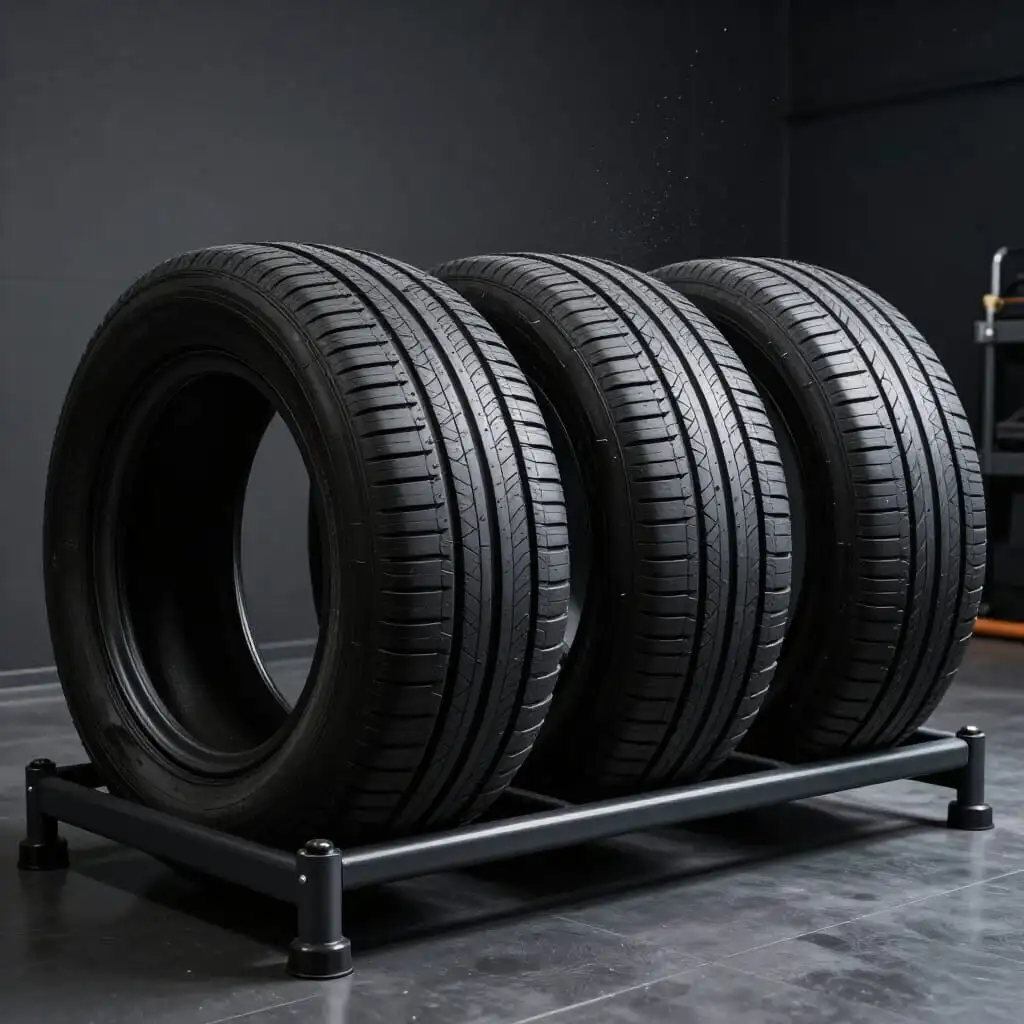
Tires without rims must be stored upright, never lying flat or stacked long-term. If left flat for several months, the weight of the tire can cause its internal structure to deform at the contact point with the ground, creating a rigid zone that can cause vibrations once the tire is remounted. When upright, the load is distributed evenly across the entire circumference. It is also recommended to slightly rotate the tires every two or three months to prevent a single contact point from permanently marking the rubber.
Conversely, tires mounted on rims should be stored flat, stacked on top of one another. The rim provides rigidity and prevents the deformation that would affect a bare tire sitting on the ground. Generally, stacks should be limited to four or five tires to avoid excessive pressure on the ones at the bottom, especially if storage lasts for several months. A popular alternative for garage tire storage is a wall mount: hooks or metal racks allow you to hang rim-mounted tires vertically, which frees up floor space and makes them easier to access. However, be careful never to hang a tire without a rim by a simple rope or a hook through the tread: the weight concentrated on a single point will irreversibly deform the carcass.
Where to Store Tires: Garage, Basement, Outdoors, or Indoors
The storage location influences the tire’s lifespan as much as its position does. The ideal setting is an indoor space that is dry, has a stable temperature between 50 and 77°F (10-25°C), and is most importantly, away from direct sunlight.
A garage is often the default choice, and it is generally a good option if it remains temperate and ventilated. A basement works well too, provided you ensure there is no stagnant humidity: high humidity levels promote mold and accelerate rubber aging, as does a floor that remains permanently damp. In both cases, avoid placing tires directly on a concrete floor: a wooden board or a pallet will insulate the rubber from residual moisture and temperature fluctuations from the ground.
Storing tires outdoors is possible but significantly less recommended, a question that often arises for those without a garage or basement. The main enemy outdoors is UV radiation, which accelerates rubber drying and cracking, followed closely by temperature swings between day and night that fatigue the internal structure. If outdoor storage is your only option, an opaque, waterproof cover placed on a raised surface and sheltered from direct rain can limit damage, though it won’t eliminate it entirely. This type of storage should remain a temporary solution for a few months, not a habit spanning several years.
Preparing Your Tires Before Storage
Storage begins before you even tuck the tire into its corner of the garage. A tire stored dirty or damp will age faster than a clean, dry one, regardless of the quality of the location.
The first step is to clean each tire with clear water and a soft brush, avoiding solvents or silicone-based products that could alter the rubber over the long term. Let them dry completely before storing them: residual moisture trapped against another surface is one of the main causes of mold and sidewall staining.
This is also the right time to inspect their general condition: look for cracks, sidewall bulges, foreign objects lodged in the tread, or irregular wear. A tire that is already weakened has a high chance of degrading further if it spends six months poorly stored. For tires mounted on rims, slightly deflating them to about 0.5 bar (approx. 7 psi) below the usual pressure limits the tension exerted on the sidewalls during long-term storage, without deflating them completely, which would conversely weaken the carcass. Finally, placing each tire in a plastic bag or a dedicated tire cover reduces exposure to air, dust, and humidity fluctuations—a particularly useful habit for winter tire storage, which often spans five to six months.
The Special Case of Motorcycle and Used Tires
Motorcycle tire storage follows the same general principles as car tires, with a few nuances related to size and use.
Motorcycle tires, which are lighter and often stored individually rather than in sets of four, should also remain upright if they are not mounted on rims. Many riders use a simple wooden stand or a dedicated vertical rack, making sure the tire never touches a heat source like a radiator or an exhaust pipe from another vehicle stored nearby. As with car tires, exposure to UV and ozone (released by certain electric motors or garage equipment) accelerates rubber aging.
For used tires intended to be resold, donated, or simply kept until they can be taken to a recycling center, the same rules of cleanliness and positioning apply, but with an additional stake: a poorly stored used tire can become unsellable or unfit for donation in just a few weeks if cracks appear on the sidewalls. If you have no immediate use for these tires, it is better to drop them off at a collection point quickly rather than storing them indefinitely in a damp corner of your garage.
Professional Storage: When to Use a Storage Service
When space is tight at home, or when you don’t have an appropriate garage or basement, the storage services offered by many garages and specialized retailers become a practical alternative.
The principle is simple: at the change of the season, the professional collects the unused set of tires, stores them in temperature and humidity-controlled conditions, and then remounts them during the following season. This service is particularly well-suited for condos or apartments where home storage is simply impossible due to lack of space. The cost is generally moderate compared to the risk of having to replace a set of tires prematurely degraded by poor storage.
This solution also offers a significant practical advantage: it avoids the need to handle heavy, bulky tires twice a year, and the professional can take the opportunity to report any abnormal wear or defects detected during storage. For households with multiple vehicles and therefore multiple sets of tires to rotate, professional storage quickly becomes easier to manage than a disorganized home setup.
Can you store tires upright without rims all year round?
Yes, this is actually the recommended position. You simply need to rotate them every two or three months to prevent a single contact point from permanently marking the rubber.
How many tires mounted on rims can be stacked?
Four to five tires maximum. Beyond that, the cumulative weight exerts excessive pressure on the tires at the bottom, especially during storage lasting several months.
Is storing tires outdoors really dangerous?
It’s not forbidden, but it is risky: UV rays and temperature fluctuations accelerate the drying and cracking of the rubber. An opaque cover and a raised surface will limit the damage without eliminating it.
Should you deflate tires before storing them on rims?
A slight deflation, about 0.5 bar (7 psi) below the usual pressure, reduces tension on the sidewalls during long-term storage without going as far as full deflation, which would weaken the carcass.
Is a basement a good place to store tires?
Yes, if it remains dry and temperate. A basement that is too humid promotes mold and accelerates rubber aging; in that case, it is better to elevate the tires on a pallet.
What is the difference between storing summer tires and winter tires?
There is no difference in method: both follow the same rules regarding position, cleanliness, and temperature. Only the duration changes, with winter tire storage often spanning five to six months compared to three to four for summer tires.
Sources
- Michelin – Tire Storage
- Pneus-Online – Complete Storage Guide
- Auto Journal – Mistakes to Avoid
- BYmyCAR – Storing tires without rims
- Point S – Storage Service

À découvrir

How to Choose Tires? Complete Guide by Usage
Learn how to choose the right tires for your vehicle and season. Discover labeling criteria, load indices, and expert practical advice.

Tire Pressure Guide: How Much to Inflate?
November 4, 2026
What Does the DOT Code on a Tire Mean? Full Guide
November 6, 2026