How to Maintain Your Car Battery? The Complete Guide
- An ICE (Internal Combustion Engine) battery lasts on average 4 to 5 years: regular checks (terminals, levels, charge) prevent premature failure.
- A car that isn’t driven should be started or connected to a trickle charger at least every 2 to 3 weeks.
- For electric or hybrid vehicles, preserving the battery primarily involves managing the state of charge (20-80%) and avoiding repeated fast charging.
- Winter worsens discharge: cold reduces available capacity and puts more strain on the starter.
- Distilled water only applies to “open” maintenance lead-acid batteries, which are increasingly rare on modern vehicles.
A weakening battery often manifests as a difficult start on a winter morning or a car that refuses to start after three weeks of sitting idle. Maintaining your car battery doesn’t require complex tools or specialized mechanical skills, but a few regular habits can make a massive difference in its lifespan. Whether your vehicle is ICE, hybrid, or electric, the requirements differ: a classic 12V battery is mostly sensitive to prolonged inactivity and cold, while an electric traction battery degrades more due to poorly managed fast-charging cycles. This guide details the best practices adapted to every situation, from cars that sit idle to winterizing and the specific needs of hybrid vehicles.
Basic Maintenance for ICE Car Batteries
On a standard combustion engine vehicle, the 12V battery powers the starter and all electrical equipment when the engine is off. Its average lifespan is between 4 and 5 years, but this can drop significantly if neglected.
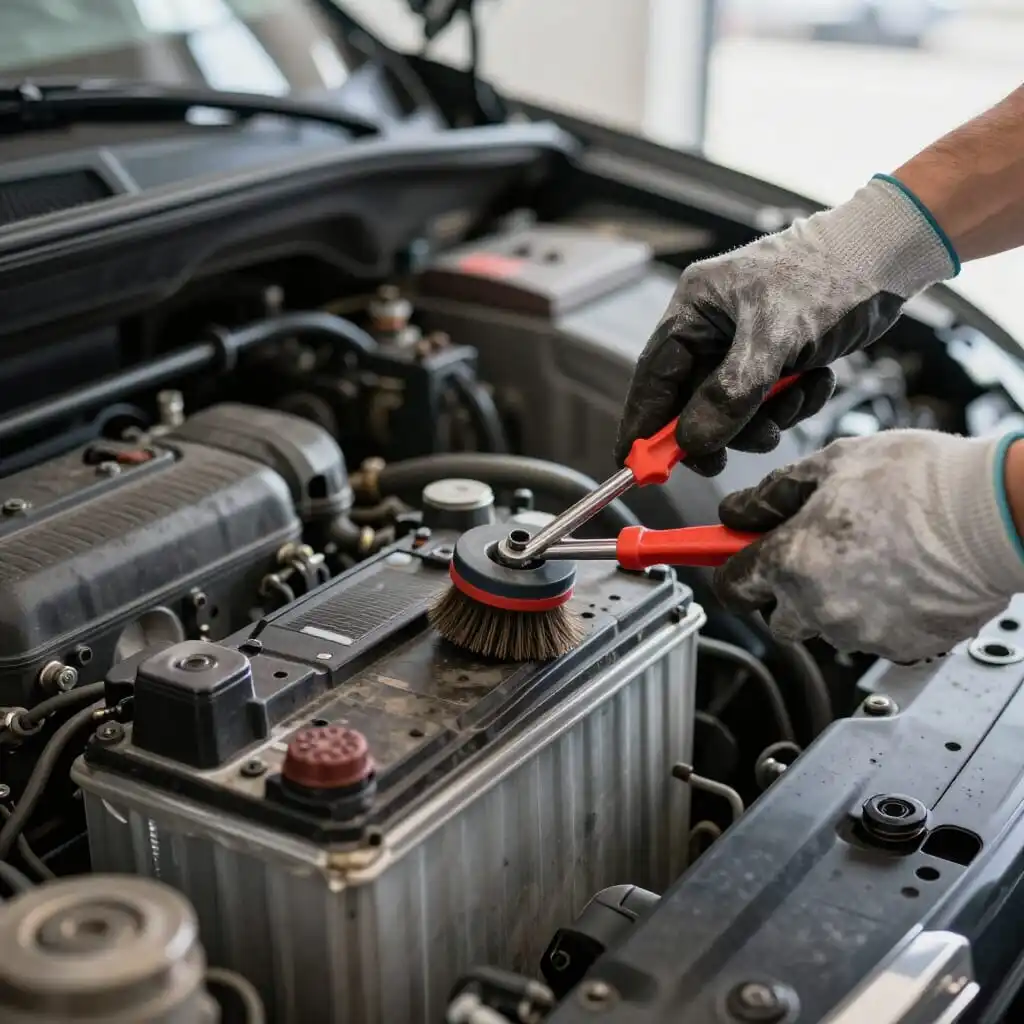
Your first instinct should be to inspect the terminals regularly: whitish or greenish oxidation on the terminals signals poor contact, which stresses the battery every time you start the car. Cleaning them with a wire brush, followed by a thin layer of specialized terminal grease, is enough to limit this phenomenon. Also, ensure that the battery fixings are tight: repeated vibrations from a loose battery accelerate internal wear on the plates.
The second key point is checking the voltage. A healthy battery should show around 12.6V at rest, with the engine having been off for several hours. Below 12.2V, it is partially discharged and deserves an external recharge before the situation worsens. A multimeter costing only a few dollars can perform this check in less than a minute.
Finally, short and frequent trips are the number one enemy of the battery: the alternator doesn’t have enough time to compensate for the energy consumed during startup. If your usage is limited to short urban trips, connecting a trickle charger/battery maintainer once a month will significantly extend its life.
Maintaining a Battery in an Unused Car
A car that sits idle for several weeks—such as a second home vehicle, a classic car, or a vehicle kept during a medical leave—will see its battery discharge naturally, even without use. This phenomenon is called self-discharge: it typically loses 1 to 2% of its capacity per day, even more if the vehicle is equipped with an alarm, a GPS tracker, or power-hungry onboard electronics in standby mode.
The simple rule is to start the engine and let it run for at least 15 to 20 minutes at least once every two to three weeks—ideally with a short drive rather than just prolonged idling in the garage. This action partially recharges the battery and prevents plate sulfation, a chemical phenomenon that irreversibly reduces capacity if the battery remains at too low a voltage for too long.
For longer periods of inactivity (several months), the best solution is a trickle charger (float charger), connected permanently to the battery via the cigarette lighter socket or directly to the terminals. Unlike a standard charger that might overcharge the battery, these devices automatically cut the current once the optimal charge is reached and restart it as soon as the level drops.
Another option for vehicles in long-term storage: disconnect the negative terminal. This cuts all parasitic electrical consumption, but it will reset your clock, radio presets, and sometimes engine control unit (ECU) settings—a compromise to evaluate based on the expected duration of inactivity.
Keeping Your Battery in Good Shape During Winter
Maintaining a car battery in winter requires special attention because cold has a direct effect on its chemical performance. A drop in temperature reduces available charge capacity: at -10°C, a battery delivers only a fraction of its nominal power, even as the starter demands more current to overcome engine oil thickened by the cold.
In practical terms, a tired battery that still started correctly in the summer might fail completely at the first frost. This is why it is wise to have your voltage and general battery condition checked before winter arrives, ideally in October or November, rather than discovering the problem on a -5°C morning.
A few precautions can limit the risks: avoid turning on all electrical equipment (heater, defroster, headlights) simultaneously just before starting, turn off the ignition if the engine doesn’t start on the first try, and let the engine run for a few minutes after a cold start to allow the alternator to recharge the stressed battery.
For vehicles parked outside without a garage, an insulating battery cover or simply parking the vehicle out of the wind can limit the impact of the cold. And, as with a car that is rarely used, a battery maintainer connected during the coldest nights can prevent many unpleasant surprises in the early morning.
The Specific Case of Distilled Water
The question of whether to use distilled water for car battery maintenance comes up often, but it only applies to one specific type of battery: “open” or serviceable lead-acid models that have visible filler caps on top. On these batteries, the electrolyte (a mixture of water and sulfuric acid) gradually evaporates due to charging, especially during long trips or in high heat.
When the level drops below the minimum mark indicated on the translucent casing, you must top it up only with distilled water. Never use tap water, as the limescale and dissolved minerals will accelerate internal corrosion of the lead plates. Refilling should be done when the battery is cold and disconnected, filling up to the maximum mark without overshooting.
That said, this type of battery is becoming a minority: the vast majority of recent vehicles are equipped with sealed AGM or EFB batteries, which have no access to the electrolyte and require no level maintenance. If your battery has no visible filler caps, this operation simply does not apply to your vehicle, and it is useless—and even risky—to attempt to open it.
Maintaining an Electric Vehicle Battery
Maintaining an electric vehicle (EV) battery is fundamentally different from maintaining a classic 12V battery: it is no longer about checking terminals or liquid levels, but about intelligently managing charge cycles to preserve the capacity of the traction battery over the long term.
The rule most often recommended by manufacturers is to keep the charge level between 20% and 80% for daily use, and to reserve 100% charges for planned long trips. A lithium-ion battery ages faster when it remains near its maximum charge for long periods or, conversely, when it is completely empty—both extremes chemically stress the cells.
The use of fast charging (DC) should also be moderated: it generates more heat in the battery than slow charging on a home or public AC station. Exclusive use of fast charging accelerates capacity degradation over several years, whereas daily slow charging at home is much gentler on the battery.
Temperature also plays an important role: exposing the vehicle to prolonged extreme heat (full sun in mid-summer, charging immediately after a fast trip) or, conversely, leaving it parked for a long time at a low charge in extreme cold is not ideal. The thermal management systems integrated into modern vehicles limit this risk, but a few common-sense precautions—such as avoiding immediate charging after a long highway drive or parking in the shade during summer—contribute to preserving the electric car battery in the long run.
Specifics of Hybrid Car Batteries
Maintaining a hybrid car battery combines two distinct logics, as these vehicles generally carry two batteries: a classic 12V battery for auxiliary equipment, and a traction battery (NiMH or lithium-ion depending on the model) that powers the electric motor.
The 12V battery in a hybrid follows the same rules as a standard ICE vehicle: monitoring terminals, checking voltage, and paying special attention if the vehicle remains stationary for long periods. In fact, this is often the first part to cause problems in an infrequently used hybrid, as the system may remain partially active in standby mode for the vehicle’s electronic management.
The traction battery, on the other hand, generally benefits from automatic management by the hybrid system itself: unlike a pure EV, the driver does not have to manually manage charge cycles; the vehicle’s computer constantly optimizes partial charges/discharges to preserve capacity. The main useful action for the driver is simply to use the vehicle regularly: a hybrid that remains stationary for a very long time will see its traction battery gradually discharge, creating a risk of degradation if it remains at a very low level for months.
Periodic diagnostic checks at a dealership or by a specialist are still recommended, especially around the 8 to 10-year mark, a period when traction battery capacity statistically begins to decline more noticeably.
How do I maintain a car battery that isn’t being driven?
Start the engine at least every 2 to 3 weeks for 15 to 20 minutes, or use a trickle charger connected permanently if the vehicle will be stationary for several months.
Do I need to put distilled water in all batteries?
No, only in open lead-acid batteries with visible filler caps. Sealed AGM or EFB batteries, which are most common on modern vehicles, do not have a level that needs checking.
What is the ideal charge level to preserve an electric car battery?
It is recommended to maintain the daily charge between 20% and 80%, reserving a 100% charge for planned long trips.
Does the cold really damage the battery in winter?
Yes, the cold reduces available charge capacity while increasing the effort required from the starter, which often reveals a tired battery that seemed to work fine in the summer.
How do I maintain a hybrid car battery?
The 12V battery is monitored just like in an ICE vehicle, while the traction battery is managed automatically by the vehicle’s system; the most important thing is to use the car regularly.
How long does a car battery last?
A classic 12V battery lasts on average 4 to 5 years, depending on usage, climate, and the quality of the driving trips.
Sources
- Oscaro – Car battery maintenance
- Mister Auto – How to maintain your car battery
- ENGIE – Electric car battery maintenance
- ChargeGuru – Electric car battery maintenance

À découvrir
How to Check Tire Pressure? A Complete Guide
Learn how to check your tire pressure easily with our complete guide. Expert tips for optimal safety and tire longevity.
How to Check Car Fluid Levels | Complete Guide
November 7, 2026
Check Engine Light On: What to Do? Complete Guide
November 10, 2026