
How to Check Your Car’s Fluid Levels | Complete Guide
- Check engine oil levels when the engine is cold or after it has been off for several minutes; never check while the engine is running and hot.
- Regularly check coolant, brake fluid, and windshield washer fluid to prevent breakdowns.
- Modern batteries do not require level checks, except for rare models with accessible electrolytes.
- A full checkup takes less than 10 minutes and prevents most avoidable breakdowns.
- Perform these checks at least once a month and before any long trip.
Checking your car’s levels involves monitoring engine oil, coolant, brake fluid, windshield washer fluid, and, on some models, the battery, to prevent mechanical failures and ensure vehicle safety. This simple, free procedure is performed with the hood open, the car parked on a flat surface, and takes less than ten minutes once mastered. It complements standard professional garage maintenance—service intervals, oil changes, and filter replacements should still be handled by a professional—but fluid levels are easy to monitor yourself between visits. This guide details which levels to check, how to do it safely without risk of burns or reading errors, and how often to repeat the process depending on your engine type.
What levels should you check on a car?
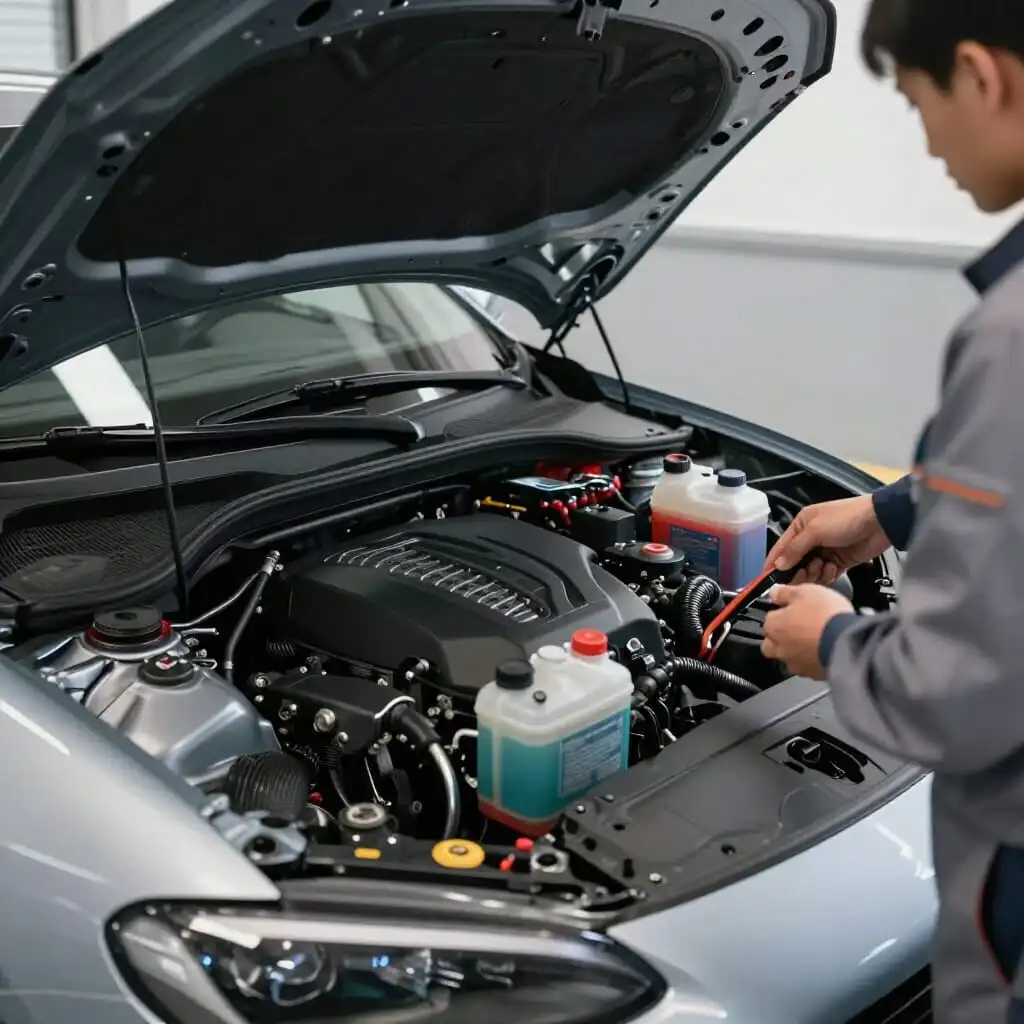
An internal combustion engine vehicle has four to five levels that require regular monitoring. The most well-known is the engine oil level, which lubricates mechanical parts and prevents premature engine wear. Next is the coolant, contained in a translucent expansion tank, which regulates engine temperature and prevents overheating. Brake fluid, located in a reservoir near the master cylinder, ensures braking efficiency and must remain above the minimum mark to avoid loss of braking power. Windshield washer fluid, while less critical for mechanics, is essential for visibility and is just as easy to check via its typically blue cap.
The battery is a special case: modern “maintenance-free” batteries no longer have caps to open or electrolytes to monitor. Only a few older models or certain utility vehicles still have removable caps for checking distilled water levels. For the vast majority of drivers wondering how to check their car’s battery level, the answer is usually to check the voltage with a multimeter or have the battery tested at a garage, rather than looking for a non-existent physical level.
Finally, on automatic transmissions, transmission fluid (ATF) also deserves occasional checks, often through a dedicated dipstick, though this task is less frequent and sometimes reserved for professionals depending on the manufacturer.
How to check engine oil levels correctly
Checking the oil level is the most frequently mentioned maintenance task, and often the most incorrectly performed. The essential rule: the car must be parked on a level surface, with the engine turned off for at least five to ten minutes, to allow the oil to drain back into the oil pan. Checking engine oil while hot, immediately after driving, results in an inaccurate reading because part of the volume remains circulating in the system.
In practice, remove the dipstick, wipe it with a clean cloth, reinsert it completely, and then pull it out again to read the level between the minimum and maximum marks engraved on the stick. A level below the minimum risks accelerated wear or even engine failure; a level above the maximum can damage seals and create overpressure in the lubrication system. If oil needs to be added, use only the viscosity recommended by the manufacturer (found in your owner’s manual) and pour it in gradually, checking the dipstick regularly between additions to avoid exceeding the maximum level.
On newer engines equipped with electronic sensors, the level may sometimes be displayed directly on the dashboard, but a manual check is still recommended at least once a month to cross-reference the information.
Coolant, brake fluid, and washer fluid
The coolant expansion tank, usually translucent and marked with min/max indicators, allows for a quick visual check without having to open anything—provided the engine is cold. Opening this tank while the engine is hot exposes you to a spray of boiling, pressurized liquid. Repeatedly low levels can indicate a leak in the system or a faulty head gasket, a critical issue to never ignore as engine overheating can lead to very expensive repairs.
The brake fluid reservoir, often near the windshield on the driver’s side, must stay between its min and max marks. A slow, gradual drop is normal due to brake pad wear; however, a sudden drop should immediately alert you to a possible leak in the braking system, requiring an urgent garage visit. Never top it up with expired fluid or fluid that doesn’t meet the manufacturer’s specified standards, as this can degrade system seals.
Finally, windshield washer fluid is the simplest level to check and top up yourself without any particular risk, using a fluid with antifreeze additives in winter to prevent freezing in the lines during extreme cold.
When to check your car’s levels?
The ideal frequency depends on vehicle usage, but a good practice is to check all levels once a month, and systematically before a long trip, a holiday, or a vehicle inspection. Older vehicles or those that consume a bit of oil between oil changes deserve more frequent checks, every 15 days for example, as an undetected small leak can escalate quickly.
This level check is part of a broader regular car maintenance routine. For a standard gasoline or diesel car, service intervals generally occur annually or every 15,000 to 20,000 km (approximately 10,000 to 12,000 miles) depending on the model, with an oil change at each interval. Even a car that is driven infrequently benefits from checking levels despite low mileage, as certain fluids degrade over time as much as through usage.
Special case: Hybrid and electric cars
Electric vehicle maintenance differs significantly from internal combustion models: without a combustion engine, there is no engine oil or oil filter to change, which considerably reduces the number of levels to monitor. The primary ones remaining are coolant—which now regulates the high-voltage battery temperature as much as the power electronics—as well as brake fluid and washer fluid, which are identical to those in a traditional vehicle. This simplification partly explains why electric vehicle maintenance costs are often lower over time, despite the higher purchase price.
Hybrid vehicle maintenance falls somewhere in between: the vehicle retains an internal combustion engine with its traditional oil and fluid levels, while also integrating electric components. Contrary to popular belief, this doesn’t fundamentally reduce the list of checks compared to a gasoline model.
In any case, the high-voltage battery in these vehicles has no level for you to check yourself: its management is entirely electronic, and monitoring it is exclusively the job of an authorized service center equipped with the appropriate tools.
Budget and where to get levels checked if needed
Checking levels yourself costs nothing, except for the price of the fluids if a top-up is required. For affordable car maintenance, this regular habit helps avoid major repairs by spotting leaks or abnormal drops early. A liter of engine oil or coolant is relatively inexpensive compared to the cost of an engine repair caused by lack of lubrication.
For motorists who are less comfortable with mechanics, maintenance networks like Norauto offer free level checks in a few minutes, often without an appointment. While Norauto car maintenance prices vary depending on the chosen services, a simple level check is usually included as a complimentary service alongside parts purchases or workshop visits. However, it is still recommended to compare maintenance prices between different garages for more significant interventions, such as a full oil change or battery replacement, where price differences can be significant.
How do I check engine oil when the engine is hot?
It is not recommended to check the oil while the engine is running and hot: wait five to ten minutes after turning it off to allow the oil to drain back into the oil pan before reading the dipstick.
How do I check a car’s battery level?
Modern batteries no longer have a level to check visually; you must measure the voltage with a multimeter or have the battery tested at a garage.
Which levels should I check in my car regularly?
Engine oil, coolant, brake fluid, and windshield washer fluid are the four essential levels to check every month.
When should I check my car’s fluid levels?
Ideally once a month, and always before a long trip or a vehicle inspection.
How do I check a car’s water level?
The coolant level can be read on the translucent expansion tank while the engine is cold; never open the cap while it is hot.
Is electric vehicle maintenance cheaper than internal combustion?
Yes, generally, because there are no oil changes or traditional filters, reducing the number and frequency of service interventions.
Sources
- idGarages – Checking Car Fluid Levels
- TotalEnergies – How to Check Car Fluid Levels
- Caradisiac – Check Fluid Levels in Five Minutes

À découvrir
How to Choose the Right Tire Size | Complete Guide
Learn how to choose the right tire size: reading codes, load indices, and speed ratings. A complete guide with practical tips for cars and bikes.
What Does the DOT Code on a Tire Mean? Full Guide
November 6, 2026
Tire Pressure Guide: How Much to Inflate?
November 4, 2026