
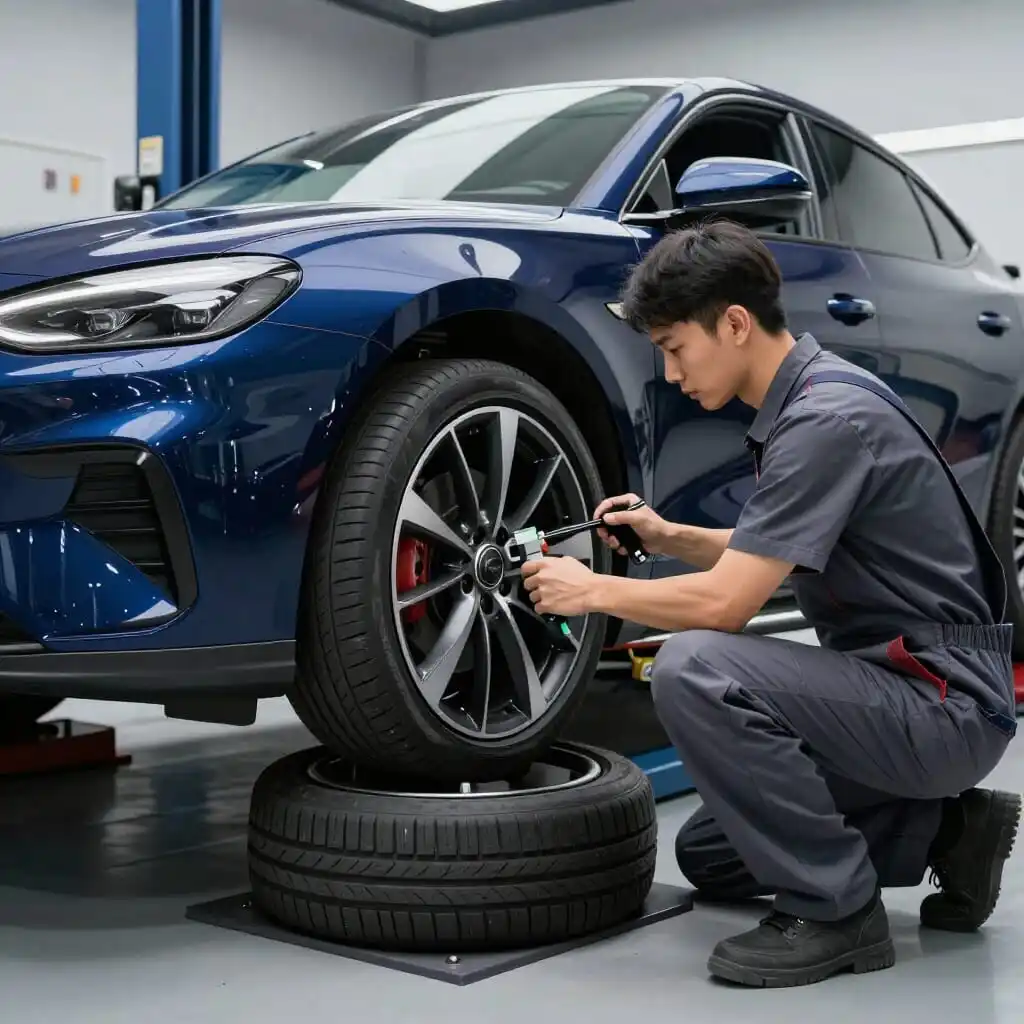
How to Reduce Tire Wear? Best Practices to Follow
- Tire pressure is the #1 factor: under-inflated tires can wear up to twice as fast on the shoulders.
- Smooth driving (acceleration, braking, cornering) significantly reduces premature rubber wear.
- Regular front-to-rear rotation and alignment checks prevent uneven wear.
- Winter tires should never be left on past the cold season, or they will wear extremely quickly on dry, warm roads.
- Neglected mechanical maintenance (alignment, shock absorbers, brakes) accelerates tire degradation.
Reducing tire wear primarily relies on three simple levers: correct pressure, appropriate driving habits, and regular mechanical maintenance. An improperly inflated tire, a misaligned drivetrain, or aggressive driving can cut the lifespan of a set of tires in half, leading to higher replacement costs and compromised braking safety. This guide details the concrete causes of wear and effective actions, season by season, to preserve your tires for as long as possible.
Why do tires wear out so fast?
Tire wear is never uniform or purely linked to mileage. Several combined factors accelerate the disappearance of the tread: vehicle weight, driving style, road conditions, but most importantly, poorly adjusted mechanical settings. A tire constantly supports the weight of the vehicle and absorbs all braking, acceleration, and cornering forces—it is the only contact point between the vehicle and the ground.
Three causes are most frequently seen by mechanics: incorrect inflation pressure, alignment issues (poorly adjusted toe or camber), and aggressive driving. Added to this are more subtle factors like wheel imbalance, worn shock absorbers, or a slightly sticking brake, which can cause asymmetric wear that is hard to spot without regular inspection.
A chronically under-inflated tire can wear up to twice as fast on its shoulders than on the center tread, because it bears more weight on the edges of the rubber. Conversely, an over-inflated tire wears primarily in the center of the tread. These deformations aren’t always visible to the naked eye on a daily basis, which is why monthly visual checks are essential.
Tire pressure: The habit that changes everything
This is the simplest and most cost-effective way to preserve your tires. The manufacturer-recommended pressure (indicated on the driver’s door sticker or in the owner’s manual) should be checked at least once a month, with cold tires, and before every long trip.
Tires naturally lose pressure over time—about 0.1 bar per month—and even more with temperature fluctuations. In winter, the cold causes pressure to drop more quickly: this is why it is recommended to inflate winter tires about 0.2 bar higher than the manufacturer’s recommendation to compensate for the drop due to low temperatures and limit rolling resistance.
Beyond wear, improper pressure also degrades handling, increases braking distances, and raises fuel consumption. Adjusting pressure to the load being carried (luggage, passengers, trailer) is just as important: driving a heavily loaded vehicle with standard pressure accelerates sidewall wear. Regular checks remain the most reliable way to preserve tires over time, far more than a simple visual check that cannot detect moderate under-inflation.
Adopting driving habits that protect your tires
Your driving style directly influences the speed of rubber wear. Sudden accelerations, late braking, and cornering too fast generate intense friction that literally tears away rubber particles with every movement. Conversely, anticipatory and smooth driving allows for a measurable reduction in tire wear over time.
A few concrete habits make a difference: anticipate slowdowns to brake gradually, avoid sudden starts, ease off the accelerator before corners rather than braking while turning, and limit steering maneuvers while stationary, which literally “scrapes” the rubber on the asphalt. Navigating speed bumps, potholes, and curbs at lower speeds also protects the tire carcass, not just the tread.
Speed itself plays a significant role: the higher the speed, the higher the rubber temperature, and the faster the wear accelerates, especially on highways during long trips. Driving at a steady speed without sudden jerks limits this overheating. These habits, accumulated over thousands of miles, can represent a significant difference in the total lifespan of a set of tires.
Mechanical maintenance: Alignment, rotation, and monitoring
Even with good pressure and smooth driving, an undetected mechanical fault can ruin a set of tires in a few months. Wheel alignment (or drivetrain geometry) deserves an annual check, or as soon as you hit a curb or a significant pothole. Poor adjustment causes “sawtooth” or uneven wear, easily recognizable on the inner or outer edges of the tire.
Rotating tires between the front and rear, approximately every 6,000 to 9,000 miles (10,000 to 15,000 km), allows for even wear. On front-wheel-drive vehicles, the front tires indeed wear faster than the rear tires because they handle steering, traction, and a large portion of the braking. This regular rotation prevents having to replace two tires individually and extends the overall life of the set.
The condition of shock absorbers and brakes also directly affects the equation. Worn shocks cause the wheel to “bounce” over road irregularities, creating characteristic wavy wear patterns. A slightly dragging brake caliper heats up and damages a tire locally without the driver noticing immediately. Regular visual inspections (tread depth, rubber appearance, presence of cracks) remain the best indicator to preserve your tires and anticipate a problem before it worsens.
Winter tires: Mistakes that accelerate wear
Winter tires have a softer rubber compound designed to remain effective in low temperatures. This softness becomes a flaw as soon as temperatures rise above approximately 7°C (45°F): the rubber softens excessively on dry, warm roads, which considerably accelerates its wear.
Leaving winter tires mounted year-round is never a good idea for preserving their lifespan: beyond the safety risks (increased braking distances, degraded handling in summer), wear accelerates significantly once warmer weather returns. The best habit is to remove them as soon as temperatures become consistently mild, generally around April depending on your region, and to store them properly (away from light and heat, slightly inflated) to also preserve the rubber during the off-season.
Conversely, to reduce the wear of winter tires during the cold season, the slightly higher pressure mentioned above, smooth driving on potentially slippery surfaces, and avoiding high-speed trips on dry roads (which wears the soft rubber faster) will allow you to get the most out of them without sacrificing them prematurely.
What pressure should I use to reduce tire wear in winter?
It is recommended to inflate winter tires about 0.2 bar higher than the manufacturer’s recommendation to compensate for the pressure drop due to the cold and to limit wear on the tire shoulders.
How often should I rotate my front/rear tires?
Rotating them every 6,000 to 9,000 miles (10,000 to 15,000 km) helps even out wear between the more stressed front tires and the rear ones.
Can I keep my winter tires all year to save money?
No: beyond the risks on dry and warm roads, the softer rubber of winter tires wears significantly faster above 7°C (45°F), which penalizes both safety and tire lifespan.
How do I know if my tires are wearing abnormally?
Uneven wear (edges, center, sawtooth patterns) usually indicates a pressure issue, alignment problem, or an associated mechanical problem (shocks, brakes) that should be checked quickly.
Does driving style really influence tire wear?
Yes; late braking, sudden acceleration, and cornering too fast pull more rubber away with every movement; anticipatory and smooth driving significantly reduces wear over time.
Should I check pressure even if there are no visible signs of under-inflation?
Yes, a tire loses pressure gradually without it being visible to the naked eye; a monthly check with cold tires remains essential to preserve the tire.
Sources
- Reduce tire wear by 30%: 7 concrete steps – Pneu Tips
- How to reduce tire wear – Feu Vert
- How to reduce tire wear – Motointegrator
- How to slow down winter tire wear – La Tribune Auto
- Winter tires all year round: good or bad idea? – Pièces et Pneus

À découvrir
How to Store Tires Correctly | Complete Guide
Learn how to store your tires correctly: ideal conditions, cleaning tips, and preservation. Avoid mistakes that damage your tires.
How to Choose Tires? Complete Guide by Usage
November 4, 2026
Tire Lifespan: Miles, Years, and Wear Signs
November 6, 2026