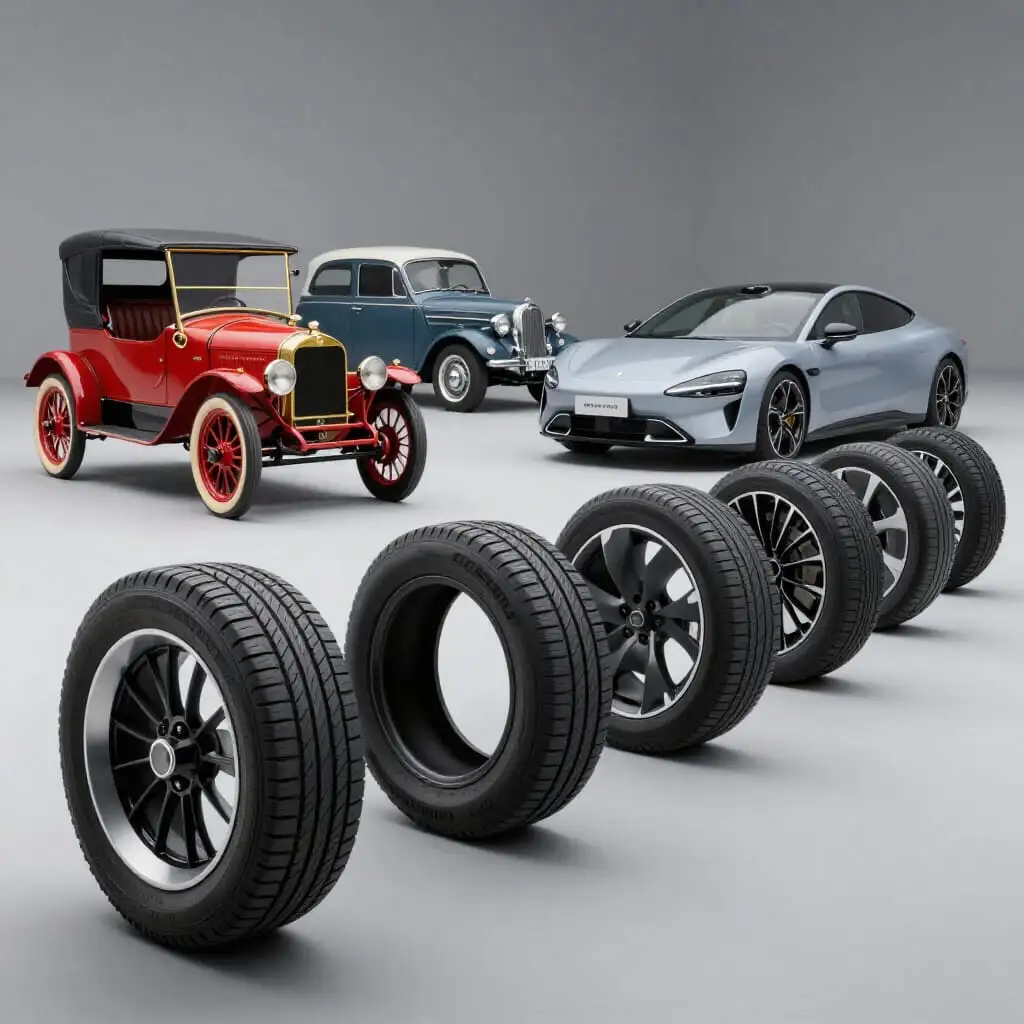
How Have Tires Evolved Alongside Cars?
- Early automobiles ran on solid rubber bands, which were uncomfortable and offered little grip.
- The invention of pneumatic (inner tube) tires, followed by tubeless tires, revolutionized comfort and road safety.
- The introduction of radial tires in the 1940s transformed handling and longevity.
- Modern compounds and tread patterns are now tailored for every use: sport, touring, winter, and off-road.
- Electric and connected vehicles are driving the demand for low rolling resistance tires and integrated sensors.
The evolution of the car tire has closely followed the evolution of the automobile itself: every mechanical advancement in a vehicle—speed, weight, engine power—has demanded a new generation of tires capable of handling it. From the solid rubber bands of the first motorized vehicles to the sensor-laden smart tires of today’s electric models, the tire has constantly reinvented itself to meet the demands of comfort, safety, and performance. This article traces this technical history step-by-step, showing how each pneumatic innovation responded to a specific need of the automotive era.
The Origins: From Solid Bands to Pneumatic Tires
Even before the automobile, tires existed in a rudimentary form for bicycles. The very first motor vehicles at the end of the 19th century inherited this fledgling technology: solid rubber bands fitted around wooden or metal wheels. This system, inherited from horse-drawn carriages, provided decent durability but almost zero comfort—every road irregularity was transmitted directly into the cabin, at a time when roads themselves were far from being paved.
It was “L’Éclair,” one of the very first automobiles to run on pneumatic (air-filled) tires rather than solid bands, that marked the true turning point for the nascent automotive sector. The inner tube, already popularized in cycling, allowed for much more effective shock absorption and significantly improved grip. In 1899, the achievement of La Jamais Contente, the first electric car to exceed 100 km/h, perfectly illustrates this close link between vehicle progress and tire progress: it ran on Michelin tires, which were at the cutting edge of available technology at the time. Without this evolution in tire technology, controlling such speeds would have been simply unthinkable.
This period established a dynamic that would never stop: every leap in engine or chassis performance is almost systematically met by an innovation in tire compound and structure.
The Era of Inner Tubes and the Democratization of the Automobile
In the early decades of the 20th century, as automobiles became more accessible and average speeds increased, the pneumatic tire with an inner tube became the standard. Its structure, consisting of a rubber-coated fabric casing and a separate inflated tube, provided vastly superior comfort compared to solid bands and allowed the vehicle to absorb the irregularities of a still very uneven road network.
This period also saw the birth of secondary uses that demonstrated the growing versatility of tires: beyond private cars, tires were used on toy cars, horse-drawn carriages, and even railway equipment. In 1929, a specific tire was designed for the Micheline, a railbus—proof that tire technology was already moving beyond the scope of traditional automobiles.
Technically, progress focused primarily on casing strength and improved tread patterns, which began to incorporate designs intended to evacuate water and improve grip on wet surfaces. As cars gained more power and higher top speeds, manufacturers also had to increase resistance to heat—a phenomenon that, during prolonged high-speed driving, could cause blowouts. This constraint would become central in the following decades as engines increased in displacement and power.
Radial Tires: The Revolution of the 1940s and 1950s
The true technological breakthrough came with the invention of the radial tire. Unlike traditional bias-ply tires, a radial tire’s carcass is made of plies arranged perpendicularly to the tread. This architecture significantly improves cornering stability, reduces rolling resistance, and markedly extends tire life compared to previous generations.
The timing of this innovation was no coincidence: the post-war era saw automakers offering increasingly faster and heavier vehicles, with more powerful engines and chassis designed for high speeds on highways—a road network that was itself expanding rapidly. The bias-ply tire, with its less laterally rigid casing, showed its limits under these conditions: uneven wear, excessive heat buildup, and compromised handling in fast corners.
The radial tire addressed these limitations precisely. It quickly became the standard in Europe before gradually dominating the United States in the following decades. This widespread adoption illustrates the overall logic of automotive tire history: a local technical innovation eventually becomes a global standard as soon as it meets a need shared by the entire automotive industry, regardless of brand or country.
Tubeless Tires and Modern Safety
Another decisive step was the gradual abandonment of the inner tube in favor of tubeless tires, where airtightness is provided directly by the tire structure and the rim without a separate tube. This system reduces the risk of sudden blowouts—in the event of a puncture, air escapes more slowly, giving the driver time to react rather than suffering a sudden loss of control.
This evolution accompanied a growing awareness of road safety, driven both by regulations and by vehicles that were becoming increasingly fast and equipped with increasingly sophisticated braking and stability systems (ABS, ESP). A tire that deflates gradually rather than exploding became an indispensable link in this global safety chain.
At the same time, tire compounds diversified. Manufacturers developed specific compounds for different uses: summer tires with high grip on hot, dry roads; winter tires that maintain flexibility in extreme cold; all-season tires for temperate climates; and specialized tires for sports cars or off-road vehicles. This segmentation directly responds to the diversification of automobile models: an urban city car, a family SUV, and a sports car no longer share the same load, speed, or usage constraints, and therefore no longer require the same type of tire.
Toward Connected Tires and the Electric Vehicle Era
Today, the evolution of the car tire is responding to a new automotive paradigm: electrification and connectivity. Electric vehicles (EVs), being heavier due to their batteries but also much quieter, impose unprecedented constraints on tires. Manufacturers are developing low rolling resistance tires designed to maximize range by limiting energy loss caused by ground friction, all while supporting a higher weight than equivalent combustion engine vehicles.
The silence of electric motors also highlights a previously masked phenomenon: road noise from the tire itself. Manufacturers are now working on tread designs and integrated acoustic foam to reduce this noise, which has become more noticeable in the absence of engine sound.
Another major trend is connected tires, equipped with sensors capable of transmitting real-time data on pressure, temperature, or wear to the vehicle’s onboard computer or a mobile app. This evolution is part of the broader logic of connected vehicles and, eventually, autonomous cars, which require reliable information about their tire condition to adjust their behavior in real time. The tire is no longer just a passive mechanical part: it is becoming a full-fledged sensor for the vehicle.
When was the first tire used on a car?
The very first automobiles used solid rubber bands without air. The transition to pneumatic tires with inner tubes for automobiles occurred at the very end of the 19th century, with models like “L’Éclair” and La Jamais Contente using Michelin tires in 1899.
What is the difference between a radial tire and a bias-ply tire?
A radial tire has carcass plies arranged perpendicularly to the tread, whereas a bias-ply tire has a crossed structure. This architecture improves stability, reduces rolling resistance, and extends the tire’s lifespan.
Why did tubeless tires replace inner tubes?
Tubeless tires are safer in the event of a puncture: air escapes gradually rather than suddenly, which gives the driver time to react and reduces the risk of losing control of the vehicle.
Why are tires for electric vehicles different?
Electric vehicles are heavier due to their batteries and are much quieter, which requires low rolling resistance tires to preserve range, as well as specific engineering to reduce road noise, which is more audible without engine noise.
What is a connected tire?
A connected tire integrates sensors that measure pressure, temperature, or wear in real time and transmit this data to the vehicle or an app. This evolution is linked to the development of connected and autonomous cars.
Sources
- Tire history: from invention to modern models
- Pneumatic (vehicle) — Wikipedia
- The history and evolution of tires since the 19th century
- Tire history: invention, evolution and modern innovations

À découvrir
Tire Load Index and Speed Rating: How to Read Them
Learn how to read your tire load index and speed rating (e.g., 91V). A complete guide to standards, thresholds, and compliance requirements.
Radial Tire: Definition, How It Works & Benefits
October 31, 2026
Tire Tread and Profile: The Complete Difference Guide
October 27, 2026