
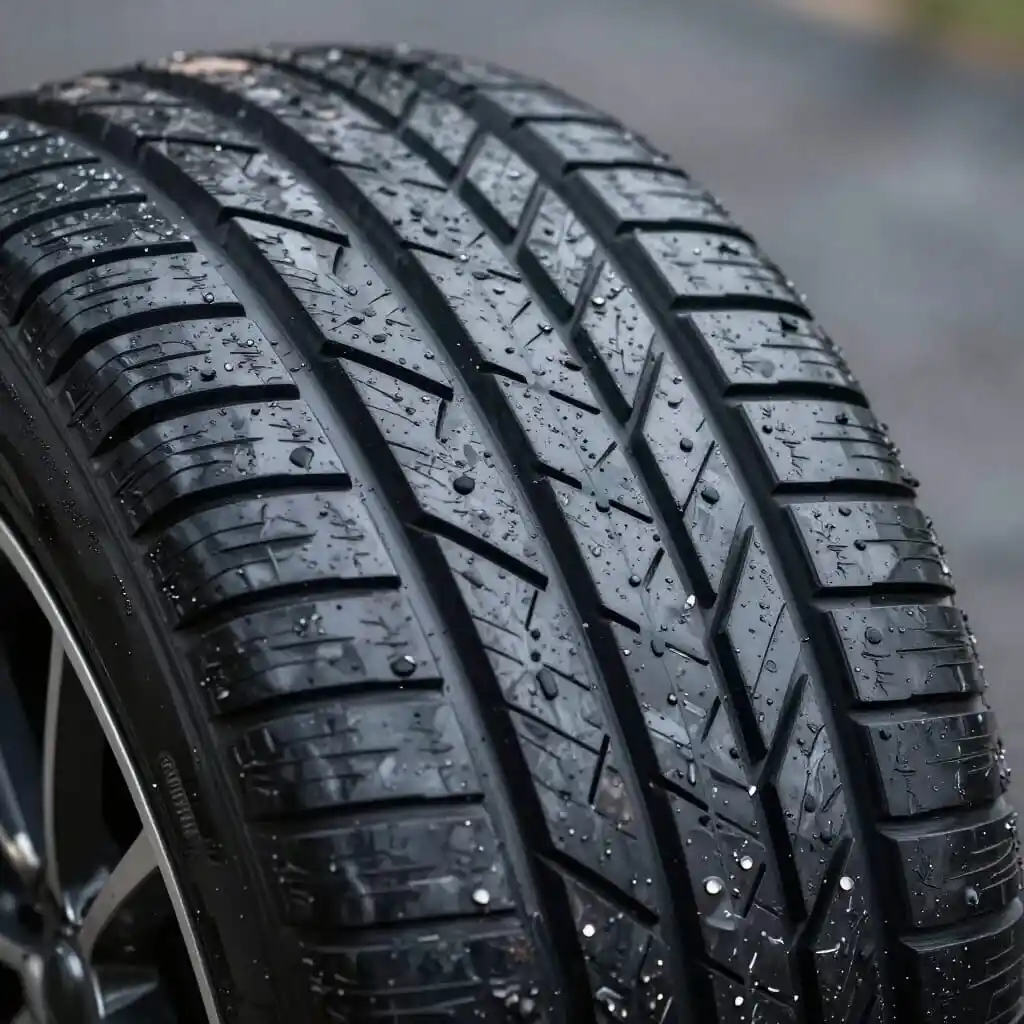
What is the Purpose of Tire Grooves?
- Grooves evacuate water from under the tire to prevent aquaplaning and maintain road contact
- The minimum legal tread depth in France is set at 1.6 mm across the entire tread
- Winter tires feature deeper and more numerous grooves to bite into snow and ice
- A new tire typically starts with a depth of 7 to 9 mm, depending on the type and intended use
- For motorcycles, groove patterns vary significantly between the center and the sidewalls
Tire grooves are the channels sculpted into the rubber of the tread. Their primary role is to evacuate water, snow, or mud that accumulates between the tire and the road, ensuring the rubber remains in direct contact with the surface. Without them, a tire would slide on a thin film of water at even moderate speeds—a phenomenon known as aquaplaning. They also contribute to cornering grip and braking by providing extra anchor points for the rubber. Their depth, number, and orientation change depending on whether a tire is designed for summer or winter, or for a car versus a motorcycle, and they wear down over time until they reach a legal limit below which driving becomes illegal and dangerous.
The Role of Grooves: Water Evacuation and Maintaining Grip
A tire groove acts as a drainage channel. When a wheel rolls on a wet road, the water present under the contact patch must be displaced in a fraction of a second so that the rubber actually touches the asphalt. This is what grooves allow: they channel the film of water toward the sides and rear of the tire instead of letting it build up under the tread surface.
This mechanism is directly linked to aquaplaning, the loss of control that occurs when a tire “floats” on a layer of water rather than rolling on the bitumen. A tire with deep grooves evacuates more water per second and delays the onset of this phenomenon, whereas a worn tire with flattened grooves loses this drainage capacity long before reaching the legal limit.
Beyond water, grooves play a mechanical role in dry grip: their edges, or “sipes,” act like tiny claws that bite into the road surface during acceleration, tight cornering, or emergency braking. This combination—drainage and traction—is why tire tread is never just an aesthetic pattern, but a technical compromise between several factors: comfort, road noise, wear resistance, and safety.
Minimum Tire Groove Depth: The Legal Limit You Must Know
In France, as in the rest of the European Union, the minimum tire groove depth is set at 1.6 mm across the entire tread, measured within the main grooves. Below this threshold, a vehicle will fail its technical inspection, and you may face a fine during a roadside check.
This limit corresponds to the position of the tread wear indicators—small raised bumps located at the bottom of the main grooves. When the tread surface reaches the same level as these indicators, the tire has reached its legal limit. This is a simple method to check without measuring tools, just by running your finger or fingernail into the bottom of the groove.
In practice, most professionals recommend replacing a tire well before this legal limit, around 3 mm, because braking performance on wet roads degrades significantly between 3 mm and 1.6 mm. The difference in braking distance on wet ground between a tire with 3 mm of tread and one with 1.6 mm can reach several meters at 80 km/h (50 mph)—a gap that often makes the difference during an emergency stop.
New Tires: What is the Initial Tread Depth?
A new tire typically starts with a groove depth ranging between 7 and 9 mm, depending on the model, brand, and intended use (touring, SUV, sport, or off-road). This reserve of rubber constitutes the available wear margin before reaching the legal limit of 1.6 mm.
This starting depth is not fixed by a single standard: a soft-compound performance tire designed for dry grip may sometimes start with shallower grooves than an off-road tire designed for mud and sand, where the tread must be wide and deep to facilitate self-cleaning.
The speed at which this reserve wears down depends on driving style, vehicle weight, tire pressure, and road conditions. An underinflated tire wears faster on the edges, which locally reduces the groove depth long before the center of the tread reaches the limit. This is why it is useful to check the depth at several points across the tread, not just in the center.
Winter Tire Grooves: Designed for Snow
Winter tire grooves are clearly distinguishable from summer tires by their number and depth. A winter tire generally features wider and more numerous grooves, combined with a dense network of small incisions called sipes, which multiply the biting edges on snow and ice.
This design allows the tire to “bite” into the snow and compress it within the grooves to create grip through snow-on-snow friction, which is more effective than simple rubber-on-bitumen contact. Winter groove depth is also generally greater than that of a new summer tire to maintain sufficient grip capacity even after several seasons of wear.
Winter tread patterns also favor more open angles to facilitate the evacuation of slush and melting snow—situations where water mixes with solid debris and can easily clog a summer-designed tread. For these technical reasons, regulations in certain mountainous regions impose a specific minimum depth for winter tires, often higher than the general 1.6 mm threshold.
The Unique Case of Motorcycle Tire Grooves
For motorcycle tire grooves, the logic differs from a car because of the tire’s very shape, which is rounded to allow for leaning in corners. A motorcycle tire tread is not flat: it transitions gradually from the center, which handles straight-line riding, to the sidewalls, which handle extreme lean angles.
This difference results in a groove pattern that varies by zone. In the center, the grooves are often more pronounced to evacuate water at cruising speeds, while on the sidewalls, the tread may be more subtle or even almost absent on certain sport tires to maximize the surface area of rubber in contact during high lean angles.
This design explains why riders must pay particular attention to sidewall wear during primarily urban or highway riding: the central grooves may wear faster, reducing straight-line drainage while leaving the sidewalls looking nearly new. This asymmetrical wear is unique to two-wheelers and does not occur in the same way on cars.
Re-grooving vs. Tire Replacement: Knowing the Difference
The term tire re-grooving refers to a technical process of re-cutting grooves into a tire using a heating tool. This practice is mainly used on heavy goods vehicle (HGV) tires and certain commercial vehicles, where an extra layer of rubber is provided during manufacturing specifically to allow for this regeneration.
This technique is not applicable to consumer car or motorcycle tires, as their rubber thickness does not include a reserve for re-grooving without compromising the tire’s structural integrity. Re-grooving a tire not designed for it exposes the driver to a loss of strength and an increased risk of a blowout, especially at high speeds.
One must not confuse professional re-grooving, which is regulated and reserved for specific transport segments, with the idea of “cutting” one’s own worn tire to extend its life: this DIY practice is dangerous and has no valid technical basis for consumer tires.
What is the minimum legal tread depth in France?
The minimum legal depth is 1.6 mm across the entire tread, which can be verified using the tread wear indicators located at the bottom of the main grooves.
What is the tread depth of a new tire?
A new tire generally starts with a depth between 7 and 9 mm, depending on the model and the vehicle’s intended use.
Why are winter tire grooves different?
They are deeper, more numerous, and include sipes to bite into snow and ice while effectively evacuating slush.
Are motorcycle tire grooves the same across the width?
No, they are often more pronounced in the center for straight-line drainage and more subtle on the sidewalls to maximize grip during cornering.
Is tire re-grooving possible for passenger cars?
No, this technique is reserved for heavy-duty tires designed with a specific rubber reserve and is not suitable for standard consumer tires.
What happens if tire grooves are too worn?
Water drainage becomes insufficient, the risk of aquaplaning increases, and braking distances on wet ground lengthen significantly.
Sources
- 1001Pneus – Tire grooves: a guide to their roles and depths
- Mondial Paris – What are tire grooves for?
- Continental – Tread depth
- Pièces et Pneus – Tire groove depth, guide to checking wear

À découvrir
Understanding Tire Dimensions: A Complete Guide
Learn how to decode car, motorcycle, and bike tire dimensions. Understand markings like 195/65 R15, load indices, and speed ratings.
Winter Tires: How They Work & Key Features Explained
October 25, 2026
Why Are Tires Black? The Science of Carbon Black
October 28, 2026