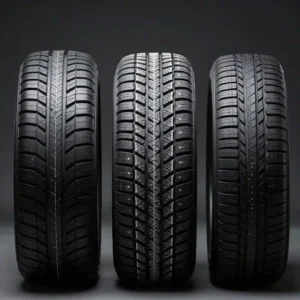

Why Are Tires Black? The Science Behind the Color
- Natural rubber is originally milky white, not black
- Carbon black was introduced in the early 20th century to reinforce tires
- This additive improves resistance to wear, UV rays, and heat
- A carbon black tire lasts significantly longer than untreated natural rubber tires
- Black is now an industrial standard, not just an aesthetic choice
If you’ve ever wondered why black tires are the absolute standard for all cars and motorcycles, the answer comes down to one thing: carbon black. Natural rubber, extracted from rubber trees, is actually creamy white or pale gray. At the beginning of the 20th century, manufacturers began adding this carbon powder to the mixture to make tires more resistant, more durable, and better protected against external elements. This technical choice, which has since become universal, explains why the shiny black tire you see at a dealership or after a car wash isn’t just an aesthetic coincidence.
The Original Color of Rubber: White, Not Black
Before understanding why blackening a car tire became systematic, we have to look at the raw material. Natural rubber, derived from the sap of rubber trees (latex), has a milky white to light gray tint once dried and processed. The very first tires, which appeared in the late 19th century, displayed this natural color. Historical photos show automobiles like the Ford Model T equipped with light, almost cream-colored tires, which look very different from the image we have today. You can actually still find this original tint on certain “whitewall” tires, which were popularized on American cars from the 1920s through the 1950s: far from being a modern aesthetic whim, this white was actually the default color of unprocessed rubber, sometimes intentionally preserved on the sidewalls for nostalgic or stylistic reasons once black had become standard on the tread.
However, this raw rubber suffered from several major weaknesses: it wore down quickly—sometimes just a few hundred miles were enough to wear out a tread—it cracked under the effects of UV rays and ozone, and it hardened over time, losing its flexibility and becoming brittle in cold weather. A white tire from that era rarely lasted more than a few thousand miles before needing replacement, a critical issue just as the automobile industry was beginning to enable long-distance travel. Engineers at pioneering manufacturers like Michelin or Goodyear were looking for ways to improve the longevity of this relatively new material. It was this quest for strength, much more than a desire to change the look of the wheels, that led to the gradual addition of additives—specifically carbon black—into the rubber formula, paving the way for the shiny black tires we know today.
The Arrival of Carbon Black: An Almost Accidental Discovery
The history of black tire coloring dates back to the early 20th century, with a breakthrough often described as an accidental discovery. Chemists working with rubber noticed that by incorporating carbon black—a residue from the incomplete combustion of hydrocarbons in the form of a fine black powder—the material gained mechanical strength and elasticity. This industrial byproduct, already used as a pigment in ink or paint, proved to be an unexpected structural reinforcement for rubber.
Tire manufacturers quickly industrialized this process during the 1910s and 1920s, gradually replacing light-colored tires with entirely black ones. This wasn’t initially a marketing choice; it was a direct response to an engineering problem. Carbon black became so effective that it remains an essential component in any rubber compound intended for tires, whether for cars, motorcycles, or heavy trucks.
What Carbon Black Actually Adds to a Tire
Carbon black is not just a coloring agent; it plays an essential functional role in tire performance. Its fine particle structure, intimately mixed with the rubber during vulcanization, creates a network that mechanically reinforces the compound. In practical terms, this additive improves several properties at once.
First, abrasion resistance: a tire loaded with carbon black resists repeated friction on the road much better, which extends its lifespan. Second, protection against UV rays and ozone: natural rubber degrades and becomes brittle when exposed to sunlight; carbon black acts as a shield that slows down this aging process. Third, better heat dissipation: it helps manage the heat generated by rolling, which limits the risk of overheating at high speeds. Finally, carbon black improves the tire’s electrical conductivity, which is important for dissipating static electricity built up by a moving vehicle.
It is the combination of these technical benefits that explains why no manufacturer has sought to return to non-carbon-loaded rubber, despite a century of progress in polymer chemistry.
Why Do Tires Sometimes Look “Shiny Black”?
Many drivers notice that their shiny black tires lose that lustrous look after a few weeks of use. This phenomenon is explained by additional agents added to the rubber mixture, which are distinct from the carbon black itself. Manufacturers often incorporate protective waxes and oils that naturally migrate to the surface of the tire—a phenomenon called “blooming”—giving new tires that characteristic satin finish.
With driving, UV exposure, rain, and repeated washing, this protective film fades, leaving behind a more matte black, or sometimes grayish, appearance if the tire ages poorly. This is why many automotive detailing products promise to “blacken” tires: they restore that shiny look by reapplying a silicone or wax film to the surface, without actually changing the internal structure or real performance of the rubber. A dull tire isn’t necessarily a failing tire, but a visual check of its general condition is always recommended.
Are There Alternatives to the Color Black?
The question comes up regularly: why aren’t there mass-produced colored tires for passenger cars? Technically, white, red, or green tires have existed, most notably the famous whitewall tires popular in the United States during the 1950s and 1960s. These models used non-carbon-loaded natural rubber on the visible part of the sidewall while maintaining a reinforced black tread.
The problem was that these light-colored areas were much more fragile and aged significantly faster than the rest of the tire. Today, some manufacturers are exploring alternative additives, such as silica, which can partially replace carbon black while maintaining good performance, particularly in reducing rolling resistance and fuel consumption. However, even these so-called “green” or eco-friendly tires remain visually black, because silica alone isn’t enough to fully replace the structural properties provided by carbon. For now, the color black remains inseparable from the performance and durability required for a modern tire.
Why are tires black instead of another color?
Because carbon black, added to the originally white natural rubber, increases resistance to wear, heat, and UV rays. This black tint is a direct consequence of this additive, not an initial aesthetic choice.
What is carbon black in a tire?
It is a fine powder resulting from the incomplete combustion of hydrocarbons, incorporated into the rubber mixture to improve its mechanical strength, durability, and heat dissipation capacity.
Why does my new tire look shiny black and then turn matte?
The shine comes from protective waxes and oils in the mixture that migrate to the surface. Through driving and washing, this film wears off, leaving a more matte black finish.
Can you blacken a faded car tire?
Yes, silicone or wax-based detailing products can restore a shiny surface effect, but this does not improve the structure or performance of the rubber underneath.
Is natural rubber really white originally?
Yes, latex extracted from rubber trees produces a milky white to light gray rubber once dried, long before any black additives are added.
Are there colored tires other than black?
Historically, yes, such as whitewall tires, but those areas without carbon black wore out much faster. No mass-market, fully colored model has stood the test of durability.
Sources
- Why Are Car Tires Always Black? — How to Save Money
- Why are car tires always black — Le Tribunal du Net
- Why car tires are black — Omni-Vision
- White Paper — Why are tires black, Magna Tyres

À découvrir
Tire Grooves: Purpose, Role, and Tread Depth
Discover the essential role of tire grooves: water drainage, grip, and safety. Learn about legal depth, wear patterns, and practical maintenance tips.

Tire Load Index and Speed Rating: How to Read Them
October 24, 2026
How are Tires Made? Industrial Process Explained
October 22, 2026