Evolution of the Automobile Tire: From Inner Tubes to Smart Tires
- The automobile tire was born in the late 19th century with the first Michelin tires fitted to the L’Éclair in 1895
- The transition from inner tube tires to tubeless tires marked a major milestone for safety and reliability
- Materials have evolved from natural rubber to compounds incorporating silica, polymers, and synthetic fibers
- Modern tires integrate sensors and electronics for real-time monitoring (pressure, wear)
- Tire evolution continues today with adaptations for electric vehicles and environmental challenges
If you’ve ever wondered how the car tire evolved from a simple rubber strip to a high-tech masterpiece, the answer lies in a series of concrete innovations rather than a single breakthrough. From the first Michelin tires fitted in 1895 to today’s smart tires, each step addressed a specific challenge: punctures, grip, longevity, and safety. This article traces this technological evolution, from the materials used to the performance requirements, to help you understand why the tires you fit today have little in common with those used by your grandparents.
From early solid rubber tires to the Michelin pneumatic
Before the invention of the pneumatic tire, vehicle wheels were equipped with solid rubber bands fitted directly onto the rim. Neither comfortable for passengers nor for the vehicle’s mechanics, these solid tires transmitted every road imperfection directly to the chassis. The year 1895 marked a turning point for the automobile: the L’Éclair car, featuring a Peugeot chassis and a Daimler engine, became the first vehicle equipped with Michelin pneumatic tires during the Paris-Bordeaux-Paris race. The concept wasn’t entirely new—John Boyd Dunlop had developed it for bicycles a decade earlier—but adapting it to the automobile represented a significant technical challenge: tires had to support much higher weights and withstand unprecedented speeds for the era.
It took several years for pneumatic tires to replace steel wheels, which were still widely used until the end of the 1900s. Punctures were frequent, mounting was laborious, and early users remained skeptical of this still-fragile technology. Intermediate solutions appeared, such as the EL elastic puncture-proof wheel in 1907, an attempt to bypass the problem of punctures without sacrificing the comfort of pneumatic tires. Nevertheless, these early 20th-century trials laid the groundwork for what would become an essential standard in the automotive industry.
The inner tube, then the shift to tubeless
For several decades, the automobile tire operated on a simple principle: an outer rubber casing surrounded an independent inner tube, which was inflated separately and responsible for maintaining pressure. This system, inherited directly from the early days of pneumatic tires, had the advantage of being relatively easy to repair, but it had one major flaw: in the event of a puncture, the loss of pressure was often sudden and total, which could make driving dangerous at high speeds.
The game-changing innovation was the arrival of the tubeless tire, where the airtight seal is provided directly by the tire carcass and its contact with the rim. If pierced by a sharp object, air escapes much more slowly, giving the driver time to react before a total loss of pressure occurs. This technology, which became standard for passenger vehicles during the second half of the 20th century, remains the norm today. It also simplified manufacturing and reduced the overall weight of the tire—two advantages that accelerated its adoption by all major automakers.
The evolution of materials and structure
Natural rubber, the historical raw material for tires, quickly showed its limits regarding wear resistance and performance in both cold and hot conditions. Manufacturers progressively introduced compounds combining synthetic rubber, silica, and carbon black, allowing them to simultaneously improve wet grip and rolling resistance—a trade-off long thought impossible to achieve. The addition of silica, in particular, helped reduce fuel consumption caused by tire rolling resistance without sacrificing road handling.
The internal structure has also changed profoundly. Bias-ply tires, where the fabric plies overlap diagonally, gradually gave way to radial tires, where the plies are arranged perpendicularly to the direction of travel. This architecture, which became widespread in the European market starting in the 1970s and 1980s, offers better stability, more even wear, and a significantly extended lifespan. Today, synthetic fibers such as polyester or steel reinforce the tire belt, combining lightness and rigidity to handle the stresses of modern vehicles, which are heavier and more powerful than those from thirty years ago.
Safety and performance: major technical advances
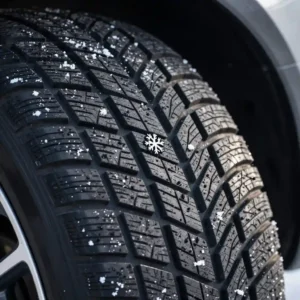
Beyond materials, the entire design of the tread pattern and the tread surface has been redesigned to improve safety. Grooves and sipes have been optimized to evacuate water more effectively, reducing the risk of hydroplaning at high speeds. “All-season” tires or specific winter tires, featuring rubber compounds that remain flexible even at low temperatures, illustrate this drive to adapt to real driving conditions rather than generic use.
Run-flat technology constitutes another notable advancement: these tires feature reinforced sidewalls capable of supporting the vehicle’s weight even after a total loss of pressure, allowing for a limited distance of driving at reduced speeds to reach a garage. Meanwhile, Tire Pressure Monitoring Systems (TPMS), now mandatory on new vehicles in many markets, alert the driver in real-time in case of under-inflation—a factor long identified as increasing the risk of punctures and higher fuel consumption. These developments reflect a shift in philosophy: the tire is no longer just a passive mechanical part, but an actively monitored component integrated into the vehicle’s safety systems.
Toward smart tires and adaptation to electric vehicles
The most recent innovations in tire evolution no longer concern just the rubber or the structure, but the integration of sensors directly into the tire. Onboard chips allow for continuous monitoring of pressure, temperature, and sometimes even tread wear, transmitting this data to the dashboard or dedicated apps. This approach to the smart tire is part of a broader trend toward vehicle digitalization, where every component becomes a source of actionable information for predictive maintenance.
The rise of electric vehicles (EVs) also imposes new constraints: these cars, heavier due to battery weight, deliver instant torque that stresses the tire differently from the very first rotation. Specific ranges, such as the Hankook iON evo, have been developed to meet these precise requirements—reducing rolling noise, optimizing range via lower rolling resistance, and increasing resistance to wear caused by high torque. This ongoing adaptation shows that the evolution of the automobile tire remains an open field, guided by the shifts in the automotive landscape itself rather than just the pursuit of raw performance.
When was the first automobile tire invented?
The first automobile pneumatic tire was fitted in 1895 on the L’Éclair car, with a Peugeot chassis and a Daimler engine, by Michelin.
What is the difference between an inner tube tire and a tubeless tire?
An inner tube tire uses an independent inflated bladder inside the casing, while a tubeless tire ensures an airtight seal directly through the carcass and the rim, resulting in a more gradual loss of pressure in case of a puncture.
What is a radial tire?
It is a structure where the internal plies are arranged perpendicularly to the direction of travel, offering better stability and more even wear than a bias-ply tire.
How have tires evolved for electric cars?
Tires for electric vehicles are designed to support higher weight, manage high instant torque, and reduce rolling resistance to preserve driving range.
What is the purpose of run-flat technology in a tire?
It allows you to continue driving for a limited distance and at reduced speeds even after a total loss of pressure, thanks to reinforced sidewalls.
Why was silica introduced into rubber compounds?
It improves grip on wet roads while reducing rolling resistance, which helps limit fuel consumption.
Sources
- L’histoire et l’évolution du pneu depuis le 19ème siècle
- Pneumatique (véhicule) — Wikipédia
- Histoire des pneus : de l’invention aux modèles actuels
- Histoire du pneumatique : invention, évolution et innovations modernes
- Hankook iON evo : le verdict après 6 000 km en voiture électrique

À découvrir
How are Tires Made? Industrial Process Explained
Discover the tire manufacturing process: mixing, assembly, and vulcanization. See how 200+ raw materials are transformed in 20-30 minutes.
Understanding Tire Dimensions: A Complete Guide
October 22, 2026
205/55 R16 Meaning: Tire Size and Markings Explained
October 23, 2026