
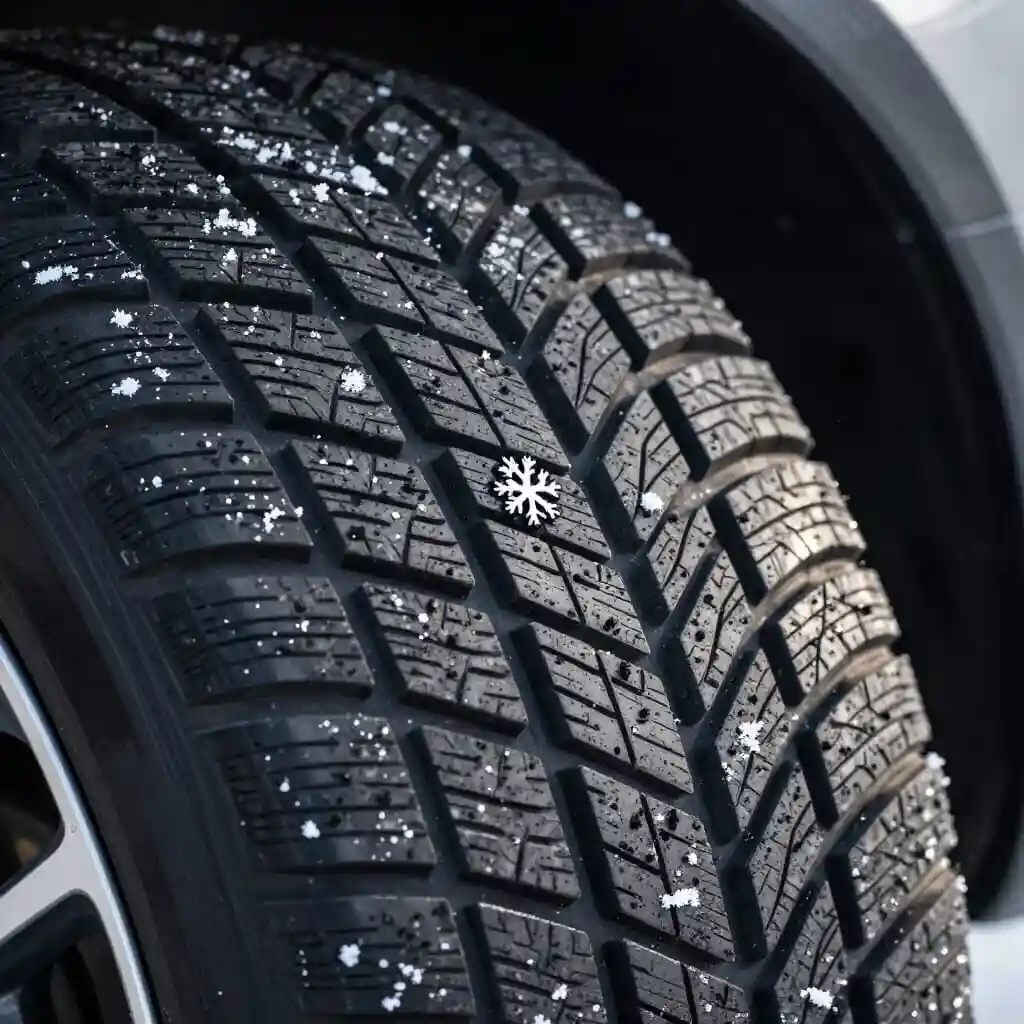
What Does the 3PMSF Marking on a Tire Mean?
- 3PMSF stands for “Three Peak Mountain Snow Flake”: a snowflake surrounded by three mountain peaks, visible on the tire sidewall
- Unlike the M+S marking, 3PMSF is issued after a regulated snow braking test
- This marking applies to both winter tires and certain certified all-season tires
- Under the “Mountain Law” (Loi Montagne), it allows you to drive legally in designated areas without chains, provided the vehicle is equipped
- All brands (Michelin, Continental, Goodyear…) must pass the same test to display this logo
The 3PMSF marking is the symbol representing a mountain with three peaks and a snowflake in its center, engraved or printed on the tire sidewall. Unlike the M+S marking, which is merely self-declared, the 3PMSF certifies that the tire has passed a regulated European snow braking test. Practically speaking, if you are looking for a tire that complies with mountain regulations or can provide true winter grip, this is the logo you should look for on the sidewall, not just the “M+S” mention, which offers no guarantee of tested performance.
Where does the 3PMSF acronym come from and what does it actually represent?
3PMSF is the acronym for “Three Peak Mountain Snowflake.” The pictogram itself follows this literally: three stylized mountain peaks with a snowflake positioned in the center. It is sometimes referred to as the “alpine symbol,” a name that directly evokes this mountain silhouette.
This marking is not just a marketing claim applied freely by the manufacturer. It results from a European technical standard (ECE R117) which requires the tire to pass a braking test on packed snow, compared to a reference tire. Only models reaching a sufficient performance index gain the right to display the logo. In other words, two tires that look visually similar, with seemingly similar tread patterns, may not behave the same on snow if one carries the 3PMSF and the other does not.
On the tire, the symbol is generally molded in relief directly into the sidewall rubber, near other regulatory markings (size, load index, speed index). It is not a removable sticker: once the sidewall is worn or the tire is too old, the marking remains visible as long as the tire carcass is undamaged.
3PMSF vs M+S: The difference that changes everything
This is undoubtedly the most common confusion among drivers. The M+S (Mud and Snow) marking is found on a vast number of tires, including some summer tires with aggressive tread patterns. The problem is that this marking is self-declared: the manufacturer applies it based on the tread geometry (spaced blocks, sipes) without any obligation to test the tire on real snow.
The 3PMSF, however, is based on a precise testing protocol: braking on packed snow, comparison to a reference tire, and a minimum performance threshold. A tire can therefore bear the M+S label without ever having proven any effectiveness on snow, whereas a 3PMSF tire has necessarily demonstrated a validated braking capability.
This difference has a direct impact on regulations: for several years, the European Union has been planning a progressive withdrawal of the recognition of the M+S marking alone for winter use, favoring 3PMSF as the single reference. For a driver, the practical rule is simple: if you are in doubt about a winter or all-season tire, look for the mountain-snowflake logo, not just the M+S mention.
Mountain Law and the legal requirement for 3PMSF
The “Mountain Law” (Loi Montagne), applicable in designated areas during the winter period, requires drivers to have either 3PMSF-certified tires (or M+S depending on transitional periods) or snow chains/socks on board in the mountain ranges listed by prefectural decree. The goal is to limit accidents and traffic congestion caused by black ice or snow on mountain routes.
In practice, a vehicle fitted with four 3PMSF tires can drive without needing to carry chains in the municipalities covered by the obligation. Conversely, a vehicle equipped with standard summer tires must imperatively have traction equipment on board, or face a fine during a roadside check.
This obligation applies to light vehicles as well as commercial vehicles and certain heavy goods vehicles, depending on specific rules. For motorcyclists, the logic is different: motorcycle tires are not subject to the same regulatory framework, as riding a two-wheeler on snow or ice is generally discouraged or even prohibited in certain mountain areas during winter, regardless of the tire marking.
Where to find the 3PMSF logo and how to check it before buying
On a tire that is already mounted, simply observe the outer sidewall: the mountain-snowflake pictogram is molded in relief, usually near the size and load/speed index markings. It can be subtle on certain models, so it is worth checking with a light or by running your finger over the relief if visibility is limited by wear or dirt.
Before purchasing, almost all manufacturers (Michelin, Continental, Bridgestone, Goodyear, Pirelli, or more budget-friendly brands like Nokian or Hankook) clearly state on the product sheet if the model is 3PMSF certified. This is particularly relevant for all-season tires: not all of them carry this marking, and an “all-season” tire without 3PMSF offers no guarantee of tested winter performance, despite its reassuring commercial name.
One point of caution: the price of a 3PMSF tire is not systematically higher than an M+S only equivalent; certification depends mostly on the range and the manufacturer’s positioning. Comparing technical specifications remains the most reliable reflex, rather than relying solely on the price displayed in-store or online.
Winter vs. All-Season tires: 3PMSF isn’t everything
The 3PMSF marking validates braking performance on packed snow, nothing more. It provides no information on the tire’s behavior on dry or wet roads, nor on its ability to maintain grip in extreme cold outside of snow itself. This is where the real difference between a dedicated winter tire and an all-season tire bearing the 3PMSF logo lies: the former uses a rubber compound designed to stay flexible below 7°C (45°F), with a specific proportion of silica and oils that prevents the rubber from hardening and losing its grip when temperatures drop—on dry cold roads, on ice patches, or on slush at the edge of the road. An all-season tire, even if 3PMSF certified, must remain versatile year-round: its compound is a compromise between summer grip and winter flexibility, which mechanically limits its performance at both extremes. In practical terms, a Michelin CrossClimate (3PMSF all-season) will brake correctly on a few centimeters of snow, but a Michelin Alpin (pure winter tire) will significantly outperform it on deep snow, frozen ruts, or prolonged ice—even though both tires display the same 3PMSF logo on the sidewall.
Pricing follows this logic: a 3PMSF all-season tire generally costs 10 to 20% more than an equivalent summer tire, but remains often cheaper than a full set of dedicated winter tires since it avoids the purchase of a second set and the cost of seasonal mounting twice a year.
For a driver who goes skiing two or three weekends per winter, or who occasionally crosses a snowy mountain pass, a 3PMSF-certified all-season tire is more than sufficient and complies with mountain regulations without the hassle of changing tires. For regular use in mountain areas, involving daily commutes on unplowed roads, crossing a pass every morning, or parking outdoors at -10°C, a set of dedicated winter tires remains the safest solution: the 3PMSF is only a minimum performance threshold validated by a standardized test, not a guarantee of absolute excellence or equivalence between two tires that display it.
What does 3PMSF mean on a tire?
3PMSF stands for “Three Peak Mountain Snow Flake”: a pictogram representing a mountain with three peaks and a snowflake in the center, certifying that the tire has passed a regulated snow braking test.
What is the difference between M+S and 3PMSF?
M+S is a self-declared mention based on tread geometry, without mandatory testing. 3PMSF is issued only after a successful snow braking test according to the European ECE R117 standard.
Is a 3PMSF tire mandatory for the Mountain Law?
Yes, in areas covered by the Mountain Law, a vehicle must be equipped with 3PMSF-certified tires (or M+S depending on the transitional period) or carry chains/socks on board.
How can I recognize a tire with the 3PMSF logo?
The pictogram is molded in relief on the tire sidewall, next to the size and load/speed index markings. It is also indicated on the product’s technical data sheet before purchase.
Do all all-season tires have the 3PMSF marking?
No, not all all-season tires carry this marking. Only models that have passed the snow braking test can display it, so you must check the product sheet before buying.
Does the 3PMSF marking guarantee good grip on dry roads?
No, it only validates braking performance on snow. Behavior on dry or wet roads, or in low temperatures, depends on other tire characteristics.
Sources
- What is a 3PMSF or M+S tire? – ALLOPNEUS
- What do M+S and 3PMSF tire symbols actually mean?
- Mountain Law – Mandatory 3PMSF marking – UFC-Que Choisir
- 3PMSF or M+S tires: which should you choose for your safety? – 1001PNEUS

À découvrir
Why Are Tires Black? The Science of Carbon Black
Discover why all tires are black: learn about the role of carbon black and its benefits for tire durability and strength.
Tire Tread and Profile: The Complete Difference Guide
October 27, 2026
What Is a Tire? Definition, Structure, and Types
October 23, 2026