What Is a Tire? Definition, Structure, and Types Explained
- A tire is a flexible rubber and composite envelope, inflated with air, that provides the contact between the vehicle and the road.
- Radial construction currently dominates the car and motorcycle markets, replacing older bias-ply technology.
- Tubeless tires are used on almost all modern cars.
- Run-flat tires allow you to drive on a flat for a limited distance thanks to reinforced sidewalls.
- A retreaded tire reuses a worn casing with a new tread, providing an economical and eco-friendly alternative.
A tire, or pneumatic, is a flexible, reinforced rubber envelope inflated with pressurized air, mounted on a rim, and designed to ensure contact between a vehicle (car, motorcycle, bicycle, truck) and the road. Its function goes far beyond simply rolling: it transmits traction, braking, and steering forces, absorbs road irregularities, and supports the vehicle’s weight. Behind this generic term lie several distinct technologies—radial, tubeless, run-flat, and retreaded—which are often confused despite serving specific needs. This article details the definition, structure, and main variations of tires to help you understand exactly what this essential road safety component entails.
Definition and Role of a Tire
The word “tire” (derived from the pneumatic principle) refers to a system based on the Greek pneuma (air, breath)—a direct reference to its core principle: a chamber filled with compressed air that cushions shocks and ensures grip. Technically, a tire is a composite object combining natural and synthetic rubber, textile fabrics, steel cables, and sometimes high-strength fibers (aramid, polyester) assembled in successive layers to form a structure that is both flexible and resistant.
Its role can be broken down into four essential functions: carrying the vehicle’s load, transmitting engine and braking forces, guiding the trajectory via steering, and cushioning road irregularities. It is the only real point of contact between the vehicle and the ground—with a contact patch roughly the size of a postcard per tire—which explains why its condition directly affects safety, fuel consumption, and handling.
It is important to distinguish the tire from the rim (the rigid metal support on which it is mounted) and the inner tube, which is only present on certain older or specialized technologies (such as some bicycles or agricultural machinery). The vast majority of modern automotive tires are designed to function without this intermediate element.
Tire Structure: Carcass, Sidewalls, and Tread
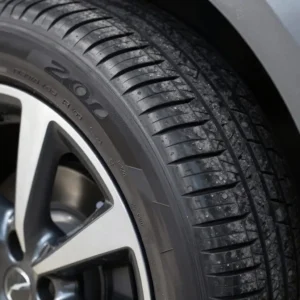
A tire consists of several distinct elements, each with a specific role. The carcass (or casing) forms the internal skeleton: layers of textile or metal cables embedded in rubber, oriented at an angle that determines the tire’s technology (radial or bias-ply). It withstands inflation pressure and deformations during driving.
The sidewalls, the visible side portions of the tire, protect the carcass and carry all the regulatory markings: brand, dimensions, load and speed indices, and manufacture date. The DOT code or the E-mark (complying with European standards) are also found on the sidewalls.
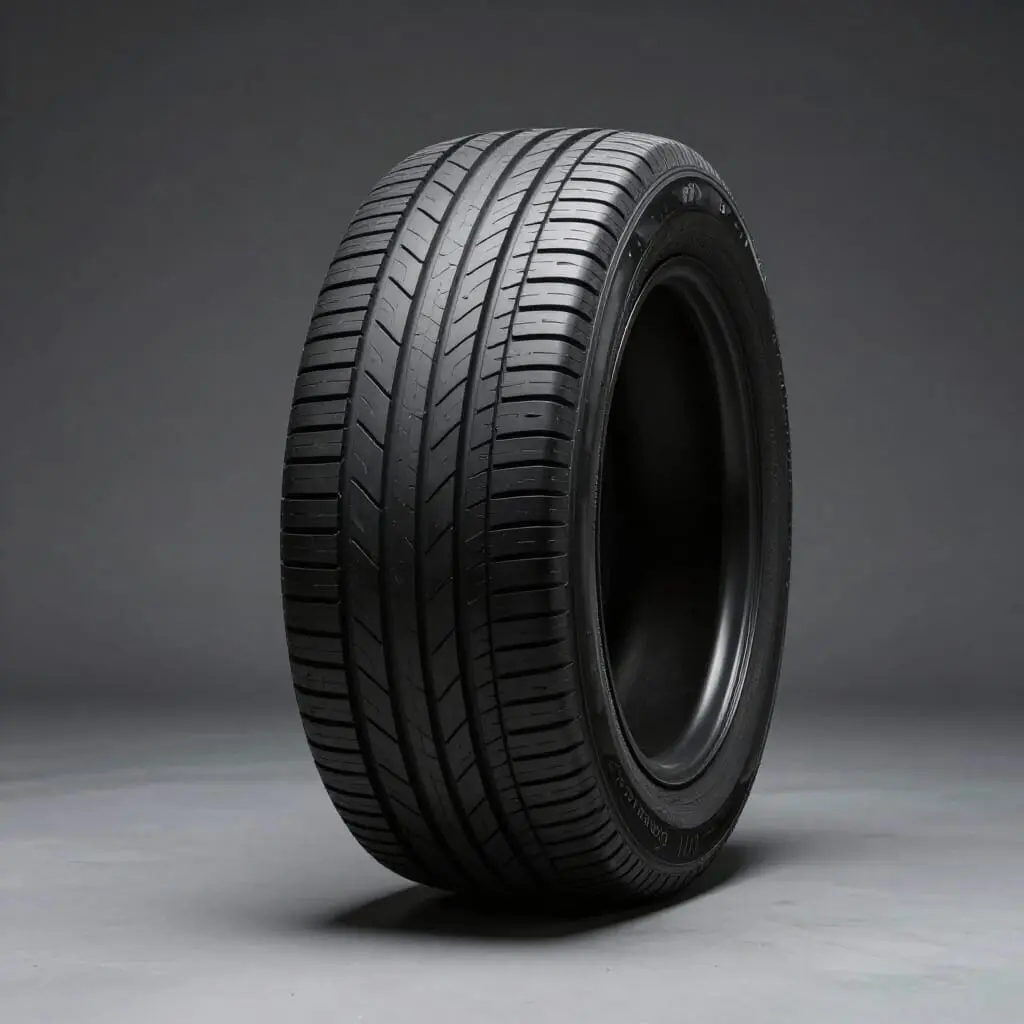
The tread is the part in direct contact with the road. Its pattern (the visible grooves and blocks) evacuates water, improves grip on wet surfaces, and largely determines the tire’s performance based on the season (summer, winter, or all-season). Finally, the bead is reinforced by a metal ring called a bead wire, which ensures the tire remains sealed and securely mounted on the rim—a critical point for tubeless tires, which must guarantee perfect airtightness without an inner tube.
Understanding Tire Dimensions
Tire dimensions are displayed in a standardized format such as 205/55 R16 91V, printed on the sidewall. The first number (205) corresponds to the tire width in millimeters. The second (55) is the aspect ratio, expressed as a percentage; this is the ratio of the sidewall height to the tire width. A “low-profile” tire (series 40 or less) offers more precision but less comfort than a “high-profile” tire (series 65 or more).
The letter R indicates radial construction, followed by the rim diameter in inches (16). Finally, the last digits and letters (91V) form the load index and the speed rating, two codified values that indicate the maximum weight supported by the tire and the maximum permitted speed under optimal conditions, respectively. Respecting these indices is not optional: using a tire with an insufficient load or speed rating is both a legal violation and a real risk of blowout.
Radial vs. Bias-Ply: Two Construction Technologies
Radial construction is now the nearly universal standard for cars, motorcycles, and heavy goods vehicles. It consists of arranging the carcass plies perpendicular to the direction of travel (at 90°), supplemented by a steel belt under the tread. This architecture offers better sidewall flexibility, more even wear, and reduced rolling resistance, which improves comfort and lowers fuel consumption.
Bias-ply technology (or cross-ply), which is older, overlaps the plies at an angle to one another. It is still used on certain specific equipment—such as agricultural machinery, light trailers, or vintage/collector motorcycles—because it offers stiffer sidewalls, which are useful for low-speed applications or heavy point loads. Visual indicator: a radial tire features the letter “R” in its markings, while a bias-ply tire uses “D” or “-” (bias).
Tubeless Tires: The Technology Without an Inner Tube
A tubeless tire ensures its own airtightness thanks to an internal layer of rubber called a liner, which is bonded to the carcass. Unlike a tube-type tire that requires a separate inner tube to hold pressurized air, a tubeless tire relies on a bead that fits perfectly against the rim to prevent any leaks.
This technology has been standard on almost all automotive tires since the 1980s and is also widely used in the bicycle and motorcycle worlds. Its main advantage: in the event of a puncture by a sharp object, air escapes much more slowly than with an inner tube, providing enough time to reach a garage rather than suffering a sudden deflation. It also reduces the risk of blowouts caused by inner tube pinching, a common incident with older tube-type setups.
Run-Flat Tires: Driving Despite a Puncture
Run-flat tires operate on a different principle: their sidewalls are significantly reinforced with additional rigid rubber capable of supporting the vehicle’s weight even at zero pressure. In the event of a puncture, the driver can continue to drive for a limited distance—usually around 50 miles (80 km) at reduced speed (maximum 50 mph / 80 km/h)—to reach a repair point without having to change a wheel on the roadside.
This technology comes standard on many premium models (BMW, Mini), which, in exchange, often do away with spare wheels to save weight and trunk space. The downside: a run-flat tire is stiffer, therefore generally less comfortable, more expensive to purchase, and requires a Tire Pressure Monitoring System (TPMS) since the visual deformation of a flat tire is no longer perceptible to the eye.
Retreaded Tires and Other Technical Terms
A retreaded tire involves recovering a used but structurally sound casing and applying a new tread that is glued and vulcanized with heat. Very common in the trucking industry and increasingly in light vehicles, retreading reduces operating costs and environmental impact by avoiding the disposal of a still-usable casing—a significant issue, given that global tire production is equivalent to about one tire per person every year.
Other technical terms frequently appear in tire terminology. A clincher tire, a term borrowed from cycling, refers to a standard tire (with or without a tube) whose edges “clinch” onto the rim using a hook—as opposed to tubular tires (sew-ups) which are glued directly to the rim. An asymmetric tire features a different tread pattern on its inner and outer sides: the outer side prioritizes cornering grip, while the inner side prioritizes water evacuation, with a specific mounting direction indicated by an “Outside” marking on the sidewall.
What is a run-flat tire?
A run-flat tire is a tire with reinforced sidewalls capable of being driven even when completely deflated, for a limited distance (approximately 50 miles/80 km) and at reduced speeds, allowing you to reach a garage after a puncture.
What is a tubeless tire?
A tubeless tire is a tire without an inner tube: airtightness is ensured by an inner liner bonded to the carcass and a bead that fits perfectly to the rim. This has been the dominant technology for cars since the 1980s.
What is a radial tire?
A radial tire is constructed with carcass plies arranged at 90° to the direction of travel, reinforced by a steel belt under the tread, offering more comfort and better longevity than bias-ply construction.
What is a retreaded tire?
A retreaded tire is a used but sound casing to which a new tread is applied, providing an economical and eco-friendly solution widely used for heavy goods vehicles.
How do I read tire dimensions?
A typical marking like 205/55 R16 91V indicates the width in mm (205), the aspect ratio (55), radial construction (R), the rim diameter in inches (16), followed by the load index and speed rating (91V).
What is an asymmetric tire?
An asymmetric tire has a different tread pattern on its inner side (for water evacuation) and its outer side (for cornering grip), with a specific mounting direction marked on the sidewall.
Sources
- Tire (vehicle) — Wikipedia
- Run-flat tires: advantages, disadvantages, and real utility
- Tubeless tires: role, advantages, and disadvantages

À découvrir
How are Tires Made? Industrial Process Explained
Discover the tire manufacturing process: mixing, assembly, and vulcanization. See how 200+ raw materials are transformed in 20-30 minutes.
Understanding Tire Dimensions: A Complete Guide
October 22, 2026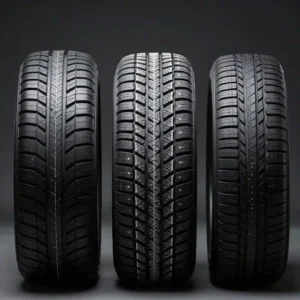
Different Tire Types: Complete Car, Moto & Bike Guide
October 24, 2026