Tire History: From Early Wheels to Modern Tires
- The wheel has existed for millennia, but the first rubber tires appeared in the 19th century
- 1888: John Boyd Dunlop patented the pneumatic tire, revolutionizing ride comfort
- 1946: Michelin invented the radial tire, patented and marketed as the Michelin X
- Brands like Kleber, Continental, or Hankook helped democratize and diversify the global market
- Modern tires integrate sensors, sustainable materials, and connectivity for safety and environmental protection
Have you ever wondered who invented the tire and how this seemingly simple object transformed global mobility? Tire history begins with solid rubber bands in the early 19th century, before shifting with the arrival of the air-filled tire invented by Dunlop in 1888. Since then, every decade has brought its own innovations: vulcanization, Michelin’s radial tire, reinforced structures, and eco-friendly compounds. This article traces the major technological and commercial milestones that shaped the tire as you know it today, from the first metal-rimmed wheels to the connected tires used in modern cars and motorcycles.
Before the Tire: From Rigid Wheels to Solid Rubber
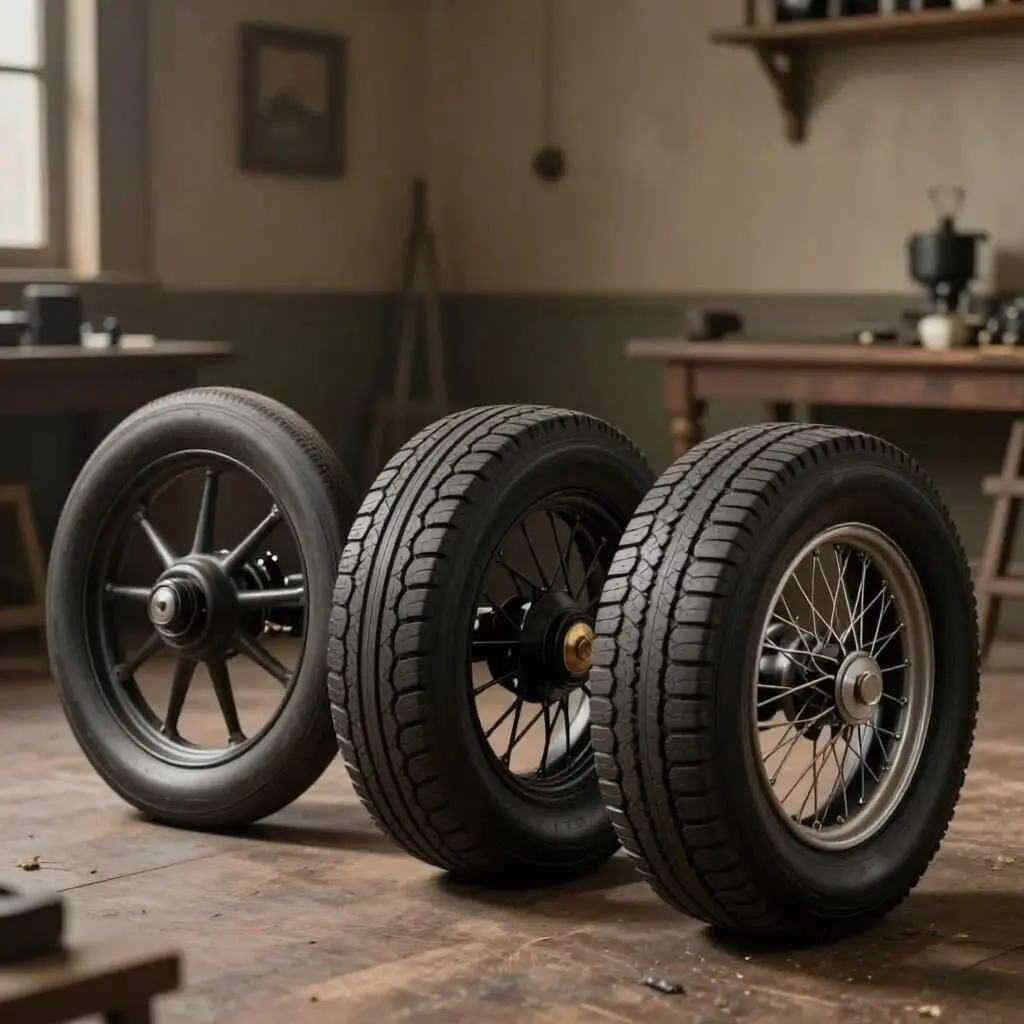
Before the tire as we know it appeared, carriage and early automobile wheels were equipped with metal rims or solid rubber bands, with no air inside. While durable, this system offered almost zero comfort: every bump in the road was transmitted directly through the chassis to the passengers. As early as 1830, Frenchman Charles Dietz had the idea of covering certain wheels with a rubber band placed between the rim and the ground—an early attempt at shock absorption. However, raw rubber at the time was brittle in cold weather and sticky in extreme heat, severely limiting its industrial use.
The real turning point came with the discovery of vulcanization by American Charles Goodyear in 1839. This chemical process stabilizes rubber, making it resistant to temperature variations by adding heated sulfur. This advancement laid the essential scientific groundwork for the rise of the pneumatic tire, even if its large-scale application on wheels would take several more decades. Without vulcanization, neither Dunlop nor Michelin could have developed the products that followed. Nevertheless, solid rubber continued to equip certain industrial vehicles long after the arrival of the pneumatic tire, proving that the two technologies coexisted for a long time before the pneumatic tire became the definitive standard.
The Invention of the Pneumatic Tire: The Dunlop Revolution
The history of Dunlop tires belongs to a Scottish veterinarian, John Boyd Dunlop, who in 1887 sought to improve the comfort of his son’s tricycle. He wrapped an air-filled rubber tube around the wheels and noticed a dramatic improvement in grip and shock absorption. He filed his patent in 1888, giving birth to the first marketable pneumatic tire. This system, much lighter and more comfortable than solid bands, quickly spread through cycling before conquering the nascent automotive industry.
The Dunlop company, founded shortly thereafter, became one of the very first major names in the tire industry and laid the technical foundations that other manufacturers would later perfect. Modern tire history truly begins at this exact moment: the tire was no longer just a passive shock absorber, but an active component of vehicle handling. Competitors soon emerged in continental Europe, particularly in France and Germany, where rubber manufacturers saw a future market tied to the rise of the automobile. The tube-type pneumatic tire became the standard for several decades—a standard that would last until the much later appearance of tubeless technology.
Michelin and the Birth of the French Tire Industry
The Michelin tire story begins in 1889 in Clermont-Ferrand, when André and Édouard Michelin took over a family rubber business inherited from their grandfather, which specialized in hoses and belts rather than mobility. The founding anecdote is well-known: a cyclist arrived at the workshop with a punctured tire that had been glued; the repair left his machine immobile all night while the rubber dried. This episode convinced the Michelin brothers that a quickly repairable tire represented a real need.
Their first major commercial success came in 1891 with a patent for a detachable tire, fixed to the rim with hooks rather than glue, making it repairable in minutes. This innovation was immediately tested in cycling competitions: as early as 1891, racer Charles Terront won Paris-Brest-Paris wearing Michelin tires, a victory that served as a public demonstration of reliability. This marketing strategy—validating the product on the racetrack—would also be applied to car racing, notably during the 1895 Paris-Bordeaux-Paris race where the car “L’Éclair” ran on Michelin tires, helping to popularize pneumatic tires against the iron-rimmed wheels still common at the time.
But the brand’s most decisive contribution remains the radial tire, patented in 1946 and marketed in 1949 under the name Michelin X. Unlike the classic diagonal tire where the carcass plies cross at an angle, a radial tire features plies perpendicular to the tread, supplemented by a steel stabilizing belt under the rubber. This architecture significantly improves longevity (up to twice as long as diagonal tires according to tests at the time), grip, and rolling resistance, which in turn leads to a measurable reduction in fuel consumption.
However, this technology did not become dominant overnight: American automakers, attached to the perceived comfort of diagonal tires, did not adopt it massively until the 1970s and 1980s, whereas European and Japanese manufacturers integrated it much earlier. This gap partly explains why Michelin invested decades of industrial effort—notably by setting up factories in the United States in the 1970s—before becoming a global tire leader. Even today, radial structures are used in almost all tires sold, whether for cars, motorcycles, or heavy trucks—a direct legacy of this mid-20th-century French invention that forever changed global tire history.
Kleber, Continental, Hankook: The Global Diversification of the Market
While Dunlop and Michelin laid the historical foundations of the tire, other manufacturers have since shaped an increasingly competitive global market. The Kleber tire story dates back to 1910 with the creation of the French brand by the Société du Caoutchouc Manufacturé, before it eventually became a subsidiary of the Michelin group while maintaining its own positioning in the mid-range segment.
In Germany, Continental developed its own patents for pneumatic tires at the end of the 19th century and became one of the historical European pillars of the industry, alongside Michelin and Dunlop. More recently, the rise of Asian manufacturers has reshuffled the global market. The Hankook tire story perfectly illustrates this dynamic: founded in South Korea in 1941, the company established itself as a global player in the 1980s and 1990s through massive investment in research and development, eventually becoming one of the world’s largest tire manufacturers by production volume. This geographical diversification has led to an overall drop in prices and a segmented offering, ranging from premium to economy tires, meeting the diverse needs of motorists and motorcyclists alike.
From Tubeless to Connected Tires: Contemporary Innovations
The second half of the 20th century and the beginning of the 21st century have seen several major technological breakthroughs. The tubeless tire, without an inner tube, became widespread from the 1950s and 1960s: it simplifies mounting, reduces slow punctures, and improves safety in case of a puncture since pressure is maintained longer.
In the 1970s and 1980s, the introduction of silica-based rubber compounds improved wet grip while reducing rolling resistance—a compromise long thought impossible to achieve simultaneously. More recently, manufacturers have integrated pressure and temperature sensors directly into the tire, allowing for real-time monitoring via vehicle onboard systems. This connectivity is part of a broader trend toward smart tires capable of communicating with driver assistance systems.
In parallel, environmental concerns are pushing manufacturers to develop compounds incorporating recycled or bio-based materials, as well as lightweight structures that reduce fuel consumption. The tire history photo archives preserved by major brands bear witness to this spectacular visual evolution, from the metal-rimmed bands of the 19th century to the high-tech, sensor-equipped tires rolling on our roads today.
Who invented the first pneumatic tire?
It was John Boyd Dunlop, a Scottish veterinarian, who patented the first pneumatic tire in 1888 after testing it on his son’s tricycle.
When did Michelin invent the radial tire?
Michelin patented the radial tire in 1946 and marketed it in 1949 as the Michelin X, an innovation that would become the global standard.
What is the difference between a diagonal tire and a radial tire?
A diagonal tire has carcass plies that cross at an angle, while a radial tire arranges them perpendicular to the tread, offering better longevity and grip.
How long have tubeless tires existed?
Tubeless tires became widespread in the 1950s and 1960s, simplifying mounting and reducing the risk of slow punctures.
What is the origin of the Kleber brand?
Kleber is a French brand founded in 1910, currently a subsidiary of the Michelin group, positioned in the mid-range segment.
Is Hankook a recent manufacturer?
No, Hankook was founded in South Korea in 1941, but its international rise primarily occurred during the 1980s and 1990s.
Sources
- Michelin History | Michelin
- Michelin — Wikipedia
- Invention of the tire (1887): A history of rubber
- Pneumatic tire (vehicle) — Wikipedia
- Tire manufacturing — Wikipedia

À découvrir
Summer Tires: How They Work & Key Features
Learn how summer tires work, their rubber compounds, and tread patterns. Discover why they are best used above 7°C for peak performance.
Winter Tires: How They Work & Key Features Explained
October 25, 2026
How are Tires Made? Industrial Process Explained
October 22, 2026