
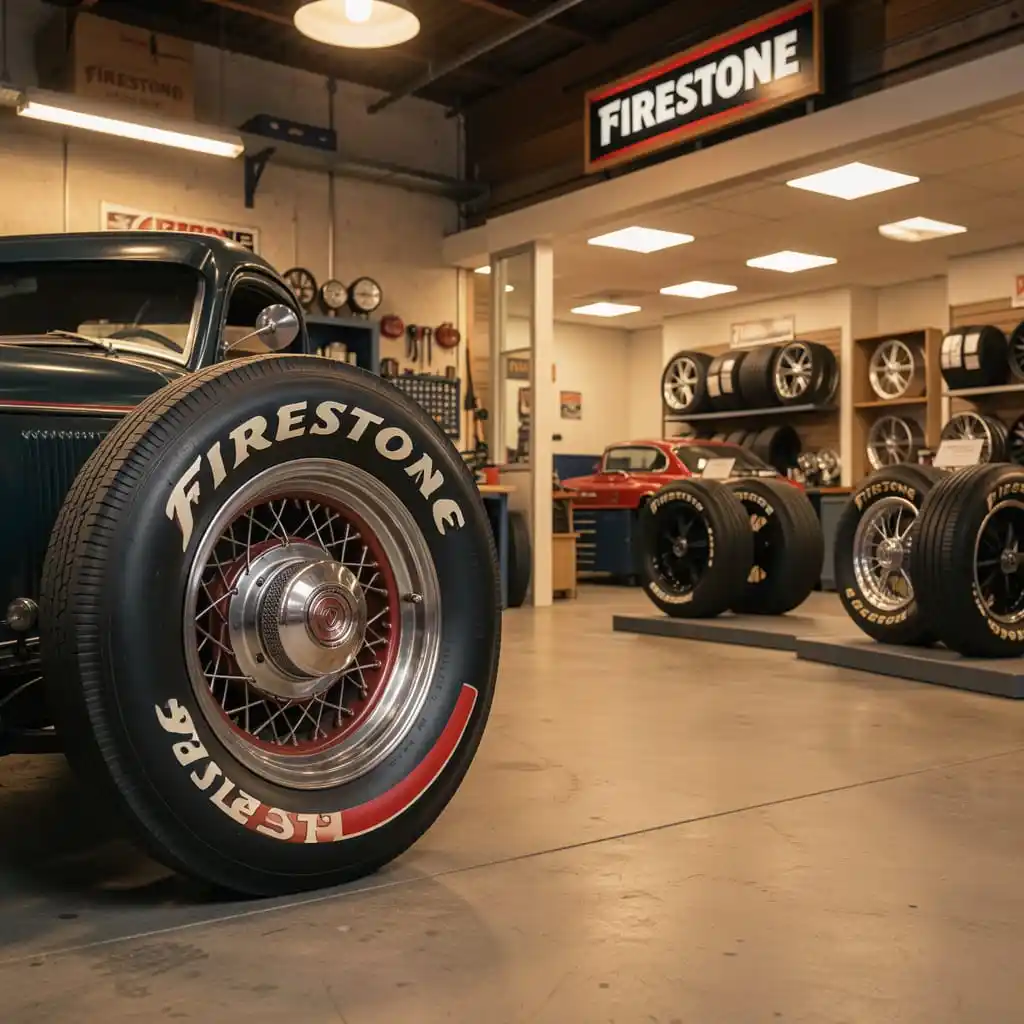
Firestone: History and Tire Range – Everything You Need to Know About the Brand
- Firestone is an American brand founded in 1900, now a subsidiary of the Japanese Bridgestone Group.
- They offer a complete range: summer, winter, and all-season tires for passenger vehicles.
- Popular sizes (175/70 R14, 185/65 R15, 195/65 R15, 205/55 R16…) are widely available.
- Positioned in the entry-to-mid-range, Firestone benefits from Bridgestone’s technical expertise.
- User reviews highlight excellent value for money, with an average rating around 4/5.
Firestone is a century-old American tire brand, now part of the Japanese Bridgestone Group, one of the world’s largest tire manufacturers. It is neither a “ghost sub-brand” nor an obscure label; it is a historical heavyweight in the automotive sector, with a name synonymous with the rise of the US tire industry at the turn of the 20th century. On the market, Firestone positions itself as a reliable and affordable alternative to premium brands, offering a wide range that covers summer and winter needs across common 14, 15, and 16-inch sizes. This article traces the brand’s history, clarifies its relationship with Bridgestone, and details its current lineup to help you choose your Firestone tires with confidence.
The Origins of Firestone: Over a Century of History
The brand takes its name from its founder, Harvey Firestone, who established the Firestone Tire and Rubber Company in 1900 in Akron, Ohio—then known as the rubber capital of the world. The company grew rapidly thanks to a strategic partnership with Henry Ford: throughout the 1900s and 1910s, Firestone supplied tires for the first mass-produced Ford Model Ts, propelling the brand to become an essential supplier for the burgeoning automotive industry.
Throughout the 20th century, Firestone kept pace with major tire evolutions: the transition from tube-type to tubeless tires, the development of radial tires, and advancements in rubber compounds. The brand also navigated challenging periods, notably a major recall crisis in the 1970s and again in the 2000s, which temporarily impacted its image in the United States.
A major turning point occurred in 1988 when the Japanese group Bridgestone acquired the Firestone Tire and Rubber Company, forming the Bridgestone/Firestone group. Firestone then became a key brand within the Bridgestone portfolio, alongside other names like Fuzion. Today, the company still employs tens of thousands of people worldwide and maintains active production plants, particularly in the United States and South America. This history explains why the brand is sometimes misspelled as “first one” or “freston” in search queries: the correct name is Firestone, and these variations do not correspond to any recognized tire brand.
Firestone and Bridgestone: What is the Exact Connection?
A common confusion arises regarding Firestone’s status: is it a “sub-brand” in a derogatory sense, or a standalone brand? The reality is more nuanced. Firestone is a brand within the Bridgestone Group, much like a subsidiary that maintains its own commercial identity, distribution network, and product lines while benefiting from the parent group’s research and development investments.
In practical terms, this means Firestone tires are not simply cheap, rebadged Bridgestone tires. They are designed and manufactured according to their own specifications, utilizing dedicated technologies such as the UNI-T rubber compound or the asymmetric tread architectures noted by various specialized comparison sites. On the other hand, Firestone indirectly benefits from Bridgestone’s quality control and industrial standards, positioning it above many low-cost Asian brands while remaining significantly more affordable than the premium Bridgestone range.
This mid-range positioning explains Firestone’s success among drivers looking for a compromise between a controlled budget and the reliability of a recognized brand. It also clearly distinguishes Firestone from generic brands sometimes mentioned in searches, which lack comparable industrial structures or technical heritage.
The Firestone Tire Range: Summer, Winter, and All-Season
The Firestone lineup covers the essential needs of the standard driver without targeting the ultra-sporty or luxury segments. On the summer tire side, the brand offers models focused on comfort and longevity, designed for the city cars and compacts that make up the bulk of the automotive market. The UNI-T technology, highlighted by many experts, aims for a balance between wet road grip, aquaplaning resistance, and even tread wear.
For winter, Firestone winter tires follow classic segment standards: multi-directional sipes, rubber compounds adapted to low temperatures to maintain flexibility, and tread patterns designed to evacuate snow and water. These are primarily intended for city and compact vehicles driving in regions with moderate winters, rather than intensive mountain driving where premium brands are often preferred.
Firestone completes its offering with all-season tires, a category seeing rapid growth as winters become milder in many regions and drivers seek the convenience of a single set of tires year-round. This segment allows drivers to avoid biannual tire changes while maintaining winter certification (3PMSF marking) on models designed for that purpose.
In terms of sizing, Firestone widely covers the fleet of European city cars and compacts: 175/70 R14, 175/65 R14, 185/70 R14, 185/65 R15, 195/65 R15, and 205/55 R16 are among the most in-demand sizes available at most retailers and fitting centers.
Is Firestone a Good Tire Brand? What the Reviews Say
On review platforms and specialized comparison sites, Firestone receives generally positive feedback, with an average rating frequently cited around 4 out of 5. Users generally praise the value for money: the brand delivers honest performance on both dry and wet roads—not quite reaching the level of premium references like Michelin or Continental, but at a much more accessible price point. Regarding the most popular ranges—such as 175/70 R14, 185/65 R15, 195/65 R15, or 205/55 R16—Firestone tire reviews converge on a single observation: the brand delivers on its promises for daily use, without major surprises or disappointments. This explains the loyalty of drivers who replace the tires on their city cars or compacts with the same references from one generation to the next.
Frequently mentioned strengths include driving comfort and even wear over the tire’s lifespan, two important criteria for daily urban or suburban use. Drivers who primarily travel in cities and on highways report good longevity, often comparable to tires sold at 20% to 30% higher prices, which bolsters Firestone’s reputation as a reliable mid-range choice. Conversely, some reviews point out slightly lower grip on wet roads compared to premium models, particularly regarding winter tires in compacted snow or icy conditions: while Firestone winter tires remain effective for occasional use in temperate zones, mountain drivers in high-snowfall regions often prefer more specialized ranges.
One point appears regularly in the comments: the confusion between the Firestone brand and similar-sounding names like “First One” or “Freston,” which have no connection to the American manufacturer and offer neither the same quality control nor the same warranty network—a useful warning when comparing rock-bottom prices on certain websites. Unlike these unknown brands, Firestone is not an anonymous sub-brand but an entity of the Bridgestone Group, which reassures buyers regarding product origin and traceability.
In short, Firestone is an excellent choice for a driver who mostly drives in the city or on the highway with a limited budget, and without frequent high-performance driving or extreme weather conditions. For light commercial vehicles, replacement tires for city cars, or a household’s secondary vehicle, the brand constitutes a credible alternative to market leaders, backed by quality control inherited from Bridgestone rather than just a marketing promise.
Is Firestone a reliable brand?
Yes, Firestone is a century-old brand owned by the Bridgestone Group, which guarantees a serious level of industrial quality control, even though it positions itself in the entry-to-mid-range rather than the premium segment.
Is Firestone a sub-brand of Bridgestone?
Firestone has been a full brand within the Bridgestone Group since the 1988 acquisition, featuring its own ranges and technologies, rather than being a simple rebadged Bridgestone tire.
What are the most common Firestone tire sizes?
The most sought-after sizes include 175/70 R14, 185/65 R15, 195/65 R15, and 205/55 R16, which are suitable for city cars and compacts.
Are Firestone winter tires effective?
They work well for moderate winters thanks to cold-adapted rubber and anti-aquaplaning treads, but they may lag behind premium brands in compacted snow conditions.
Are “First One” or “Freston” tire brands?
No, these are spelling variations resulting from typos or incorrect searches: the existing brand is Firestone, a subsidiary of Bridgestone.
Is Firestone a good brand for a small budget?
Yes, that is one of its main selling points: a great compromise between the reliability of a recognized brand and a more accessible price than premium references.
Sources
- Firestone Tire and Rubber Company — Wikipedia
- Firestone Tire Heritage and Innovation
- Firestone Tire Reviews: Performance, Models, and Cost — Vroomly
- Firestone Reviews — 1001PNEUS

À découvrir
Toyo Tires: History & Premium Japanese Tire Range
Discover Toyo Tires, a Japanese manufacturer since 1945. Explore the Proxes and Observe ranges, technologies, and 4.6/5 customer reviews.
Goodyear: History and Tire Range | Top 3 Global Manufacturer
November 14, 2026
Ford Cars: Complete Model and Engine Guide
November 22, 2026