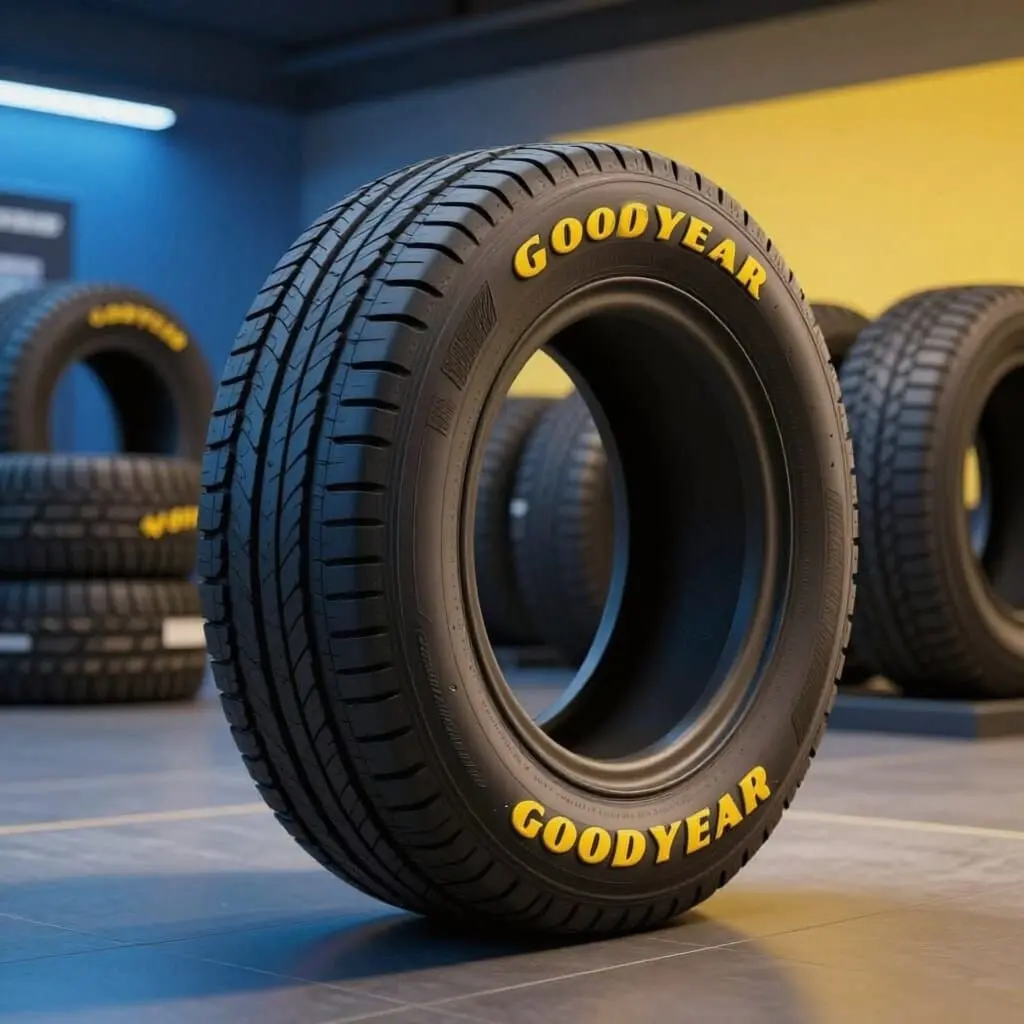
Goodyear: History and Product Range of the American Tire Brand
- Goodyear was founded in 1898 in the United States, named after Charles Goodyear, the inventor of vulcanization
- Today, the brand is the world’s 3rd largest tire manufacturer, following Michelin and Bridgestone
- The range covers summer, winter, and all-season tires, with flagship lines such as Vector 4Seasons and UltraGrip
- Goodyear is also developing future technologies: connected tires and airless tires
- Consumer reviews primarily praise handling and durability, with a premium pricing strategy
If you are looking to understand the Goodyear brand before purchasing a new set of tires, here is the essential information: it is one of the oldest tire manufacturers still in operation, founded in 1898 in the United States, and currently the third-largest global player in the sector. Its reputation has been built on automotive competition (Formula 1, endurance racing) and a massive product range spanning from family all-season tires to technical winter tires, as well as innovations like airless tires. This article traces the brand’s history and details its current range to help you understand the true value of Goodyear tires when making your choice.
A History Born of Vulcanization, Not the Founder
Contrary to what the name suggests, Goodyear was not founded by Charles Goodyear himself. The company was established in 1898 by Frank Seiberling in Akron, Ohio, who chose this name to honor the inventor of rubber vulcanization—a process discovered decades earlier, without which no modern tire would exist. This choice was significant: at the end of the 19th century, the burgeoning automotive industry needed tires capable of resisting wear, heat, and deformation, which is exactly what the vulcanization process enables.
Akron quickly became the “tire capital of the world,” with several competing manufacturers based in the same city. Goodyear gradually established itself through massive investment in research and development, a strategy that would become the company’s hallmark throughout the 20th century. The firm diversified its activities early on: automotive tires, but also tires for aircraft and heavy trucks—a positioning that allowed it to weather economic crises by relying on multiple markets.
The most recognizable symbol to the general public remains the Goodyear Blimp, used for advertising since the 1910s and still seen today above major American sporting events. This image, combined with its continuous presence in motorsport, has built a level of brand awareness that few competitors can claim with such longevity.
Goodyear Today: A Top 3 Global Player
Over a century after its creation, Goodyear remains a pillar of the tire industry. The brand is currently ranked among the top three global manufacturers, alongside Michelin and Bridgestone, with factories spread across several continents and a catalog covering all segments: passenger cars, SUVs, heavy goods vehicles, agricultural, and aviation.
This leadership position was largely built through the brand’s sporting commitment. Goodyear long served as the sole supplier for Formula 1 and continues to be present in several endurance and rally championships. This competitive arena serves as a laboratory: the rubber compounds and carcass architectures tested on the track are then integrated into consumer ranges, a classic technology transfer mechanism used by premium manufacturers.
In Europe, Goodyear has also built a brand image associated with safety and performance in challenging conditions, a positioning reinforced by its consistent results in independent comparative tests conducted by automobile clubs and specialized magazines. This dual legitimacy—historical and sporting—explains why the Goodyear brand remains a go-to reference for motorists when discussing major tire brands.
Summer and All-Season Tire Ranges
For everyday use, Goodyear offers two main families of non-winter tires. Summer tires, designed for climates without snow or ice, focus on rubber compounds optimized for grip on dry and wet roads, with controlled wear over long distances.
However, the most sought-after line is the Vector 4Seasons range, designed for drivers who drive year-round in regions with moderate winters, without abundant snow or frequent ice. This type of tire eliminates the need for seasonal changes and is particularly suitable for urban or suburban drivers with lower annual mileage. The technical compromise lies in the rubber: it is softer than a dedicated summer tire to maintain performance in cold weather, yet rigid enough to prevent premature wear in summer.
Regarding Goodyear all-season tire reviews, user feedback generally converges on two points: excellent daily versatility and braking on wet roads, which is often cited as a strength. However, there is the usual caveat for this type of product—an all-season tire is a compromise; it will never perform as well as a pure summer tire in summer, nor as well as a dedicated winter tire in heavy snow or severe ice conditions.
Winter Range: UltraGrip and Snow Technologies
In the winter segment, Goodyear relies primarily on its UltraGrip range, which is tailored to different uses: city cars, sedans, and SUVs. These tires feature 3D sipes and silica-enriched rubber compounds designed to remain flexible even in freezing temperatures—an essential condition for good grip on cold ground, even without snow.
The 3PMSF marking (Three-Peak Mountain Snowflake symbol) certifies that the tire meets minimum performance requirements on snow, a standard that has become mandatory in several European countries during the winter season. Goodyear’s UltraGrip tires meet this certification, making them a relevant choice for mountainous areas or harsh winters.
In Goodyear winter tire reviews, users regularly highlight traction when starting on snowy hills and stability during braking on cold, wet surfaces—two decisive criteria for safety in real-world winter conditions. The usual point of caution is the price, as the brand positions itself in a more premium segment compared to budget manufacturers; however, this price gap is generally justified by consistent performance throughout the tire’s lifespan.
Innovations: Connected and Airless Tires
Beyond classic ranges, Goodyear is investing heavily in disruptive technologies across two main axes. The first concerns connected tires, which integrate sensors capable of transmitting real-time data on pressure, temperature, or wear. This technology is already being deployed in certain professional segments (notably heavy truck fleets) before a gradual rollout to the general public.
The second axis, more visible in the media, is the airless tire, presented by Goodyear via several prototype concepts for about a decade. The principle: replace the traditional pneumatic chamber with a cellular or spiral structure that provides its own cushioning, thereby eliminating the risk of punctures. This technology primarily targets urban fleets, autonomous vehicles, and certain professional uses where downtime due to a puncture represents a significant cost.
To date, Goodyear’s airless tire remains mostly at the prototype stage and is not yet widely available for consumer vehicles in dealerships. Nevertheless, it illustrates the brand’s long-term strategy: continuing to invest in research, much like its beginnings with vulcanization, to anticipate the evolution of mobility rather than limiting itself to selling traditional tires.
What Do Goodyear Brand Reviews Really Say?
When looking at the overall Goodyear tire reviews available on comparison sites and automotive forums, a fairly clear consensus emerges. The most frequently cited strengths are handling on wet surfaces, rubber longevity, and consistent performance over time—criteria directly inherited from the expertise accumulated in motorsport.
The main recurring criticism concerns the price: Goodyear positions itself in the premium segment alongside Michelin, Continental, or Bridgestone, with prices often 15% to 30% higher than mid-range brands. For a motorist who drives little or is primarily looking for the lowest price, this positioning can be a deterrent.
On the other hand, for intensive use (high mileage, frequent highway driving, varied weather conditions), the investment is generally justified by slower wear and more predictable behavior over the long term—two factors that directly impact the real cost-per-mile of the tire, not just the initial purchase price.
Is Goodyear a good tire brand?
Yes, Goodyear is one of the top three global manufacturers and benefits from a technological heritage rooted in motorsport, with performance that is regularly praised in comparative tests, particularly on wet roads.
What are Goodyear all-season tires like in customer reviews?
Reviews are generally positive regarding versatility and wet braking, but they remind users that an all-season tire is a compromise—less effective than a summer tire in summer and less effective than a winter tire in heavy snow or ice.
Are Goodyear winter tires snow-certified?
Yes, the UltraGrip range carries the 3PMSF marking (snowflake inside three peaks), which certifies minimum snow performance and meets current regulatory requirements in several European countries during winter.
Is the Goodyear airless tire available for private individuals?
No, to date, Goodyear’s airless tire remains primarily in the prototype stage and is targeted at professional or fleet use, with no mass commercialization for private vehicles.
Why are Goodyear tires more expensive than other brands?
Goodyear positions itself in the premium segment, like Michelin or Continental, with an additional cost that is generally offset by slower wear and more consistent performance over time, reducing the real cost-per-mile.
How long has the Goodyear brand existed?
The brand was founded in 1898 in the United States by Frank Seiberling, in honor of Charles Goodyear, the inventor of rubber vulcanization.
Sources
- Goodyear Tire & Rubber — Wikipedia
- Goodyear History, Global Tire Giant – cultureauto.fr
- Which Goodyear tire to choose? | CentralePneus.fr Guide
- Goodyear Tires — official website

À découvrir
Michelin Tires History & Range | Global Tire Leader
Discover Michelin's history since 1889, the radial tire innovation, and their complete range for cars, motorcycles, and bikes. A global tire leader.