
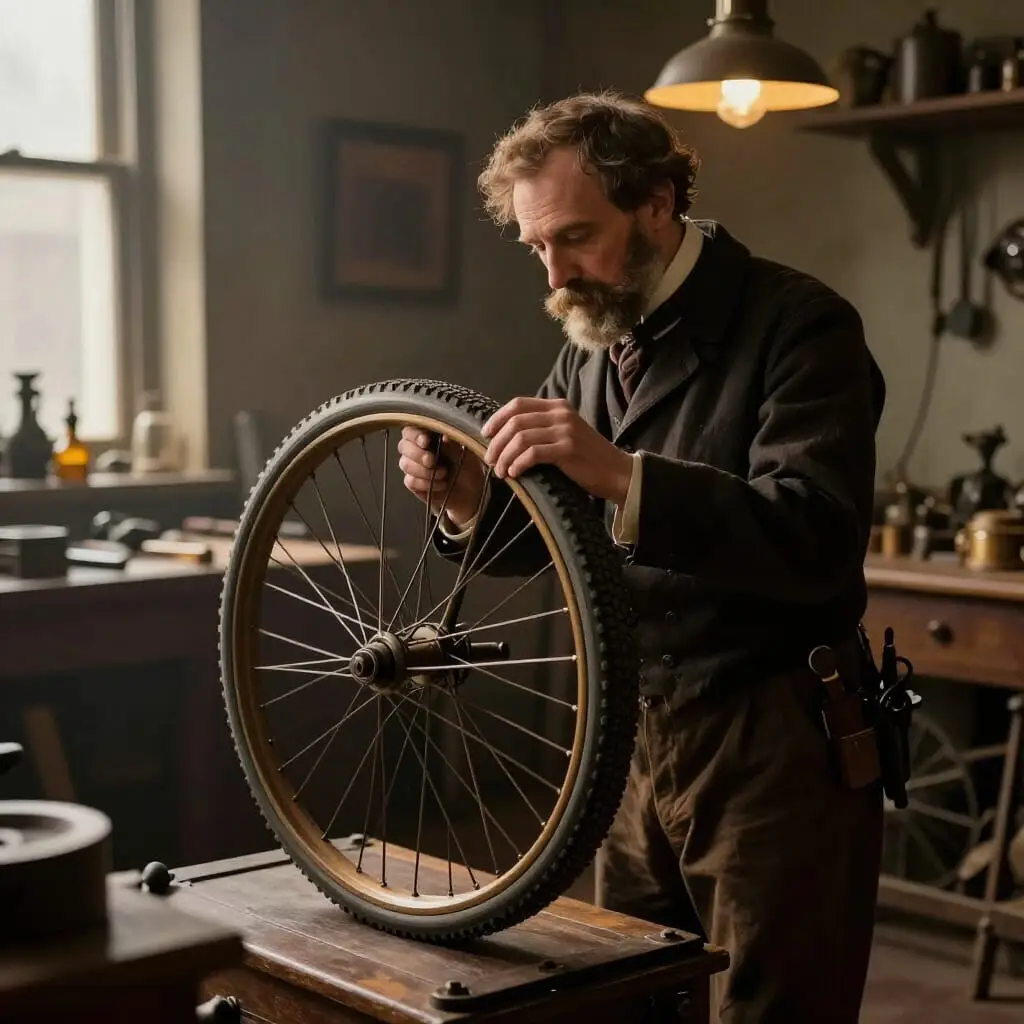
Who invented the tire? History of the real inventors
- Vulcanized rubber, the foundation of the modern tire, was invented by Charles Goodyear in 1839.
- The first patent for an inflatable tire belongs to Robert William Thomson, as early as 1845.
- John Boyd Dunlop popularized air-filled tires in 1888 for bicycles.
- Édouard and André Michelin invented the detachable tire in 1891, followed by the radial tire in 1948.
- There is no single inventor, but rather a succession of complementary innovations.
There isn’t just one inventor of the tire, but four key names that followed one another over more than a century. Charles Goodyear discovered the vulcanization of rubber in 1839, making the material industrially usable. The Scotsman Robert William Thomson filed the first patent for an inflatable pneumatic band in 1845. John Boyd Dunlop rediscovered and popularized this principle in 1888 for bicycle wheels. Finally, Édouard and André Michelin invented the detachable tire in 1891, before Michelin secured its next major milestone in 1948 with the invention of the radial tire—a structure still used today. Each innovator solved a different problem: the material, compressed air, ease of use, and finally, performance.
Charles Goodyear, the inventor of vulcanization
Before discussing tires, we must talk about rubber. In its raw state, natural rubber becomes sticky in the summer and brittle in the winter, making it unusable for long-term industrial use. Charles Goodyear, a self-taught American chemist, spent years searching for a way to stabilize this material. In 1839, often by accident according to historical accounts, he discovered that heating rubber mixed with sulfur made it resistant, elastic, and stable over time: this is vulcanization.
This process changed everything. Without it, neither solid rubber bands nor inflatable tires could have existed durably. Goodyear filed his patent in 1844, but despite the monumental importance of his discovery, he died penniless in 1860, burdened by debt and patent litigation. His name was adopted much later by the American tire brand, though there is no direct lineage to the inventor himself. Nevertheless, Goodyear remains the founding figure: without vulcanization, there would be no modern tire, whether pneumatic or solid.
Robert William Thomson, the forgotten patent of 1845
It was a Scottish engineer, Robert William Thomson, who filed the very first patent in 1845 describing a pneumatic band: a rubber casing containing compressed air, mounted on a rim and designed to cushion the shocks of horse-drawn vehicle wheels. The principle was already that of the tire as we know it today, nearly forty years before Dunlop.
Thomson’s problem was not technical, but industrial: at the time, manufacturing remained artisanal and expensive, and the automotive market did not yet exist. His invention found no viable commercial outlet and fell into oblivion for decades. Today, historians agree on recognizing Thomson as the true inventor of the inflatable tire principle, even before the word “pneumatic” became popularized. This precedence explains why some historical texts mention the invention of the tire as early as 1830–1845, rather than 1888, the date generally associated with Dunlop.
John Boyd Dunlop, the man who made the tire popular
In 1888, John Boyd Dunlop, a Scottish veterinarian living in Ireland, sought to improve the comfort of his young son’s tricycle. He wrapped the wooden wheels in a rubber tube inflated with air and glued to the rim. The improvement in comfort and speed was immediately noticeable, especially during cycling races where bicycles equipped with this system outperformed their competitors using solid rubber tires.
Dunlop filed his patent on December 7, 1888. Unlike Thomson, he benefited from a favorable industrial climate: the rise of the bicycle created immediate demand for this innovation. It was this rapid commercial success that made Dunlop the name most associated, in the collective imagination, with the invention of the tire. However, his main drawback remained the difficulty of repairs in the event of a puncture: the tire was glued to the rim, making any intervention long and tedious. This flaw paved the way for the next innovation, driven by the Michelin brothers.
Édouard and André Michelin, from detachable to radial tires
In 1891, brothers Édouard and André Michelin filed the patent for the first detachable tire, featuring an independent inner tube that could be repaired in less than fifteen minutes, compared to several hours for a glued Dunlop tire. This innovation radically changed how tires were used on the bumpy roads of the era, where punctures were frequent.
Michelin then accompanied the rise of the automobile: in 1895, the “L’Éclair” car, equipped with Michelin tires, participated in the Paris-Bordeaux-Paris race, marking the first steps of the automotive tire. But it was in 1948 that the Clermont-Ferrand firm made its greatest technical contribution with the invention of the radial tire, where the carcass plies are arranged perpendicularly to the tread rather than diagonally. This architecture permanently improved resistance, handling, and tire longevity, becoming the global standard still used on almost all tires sold today.
From bias-ply to smart tires: continuous innovation
The history of the tire did not end in 1948. After the radial tire, manufacturers continued to innovate to meet new uses, with each technical advancement addressing a limitation of the classic inflatable tire. Even before the radial, the bias-ply tire (the direct descendant of John Boyd Dunlop’s invention and perfected by the Michelin brothers) remained the norm until the 1950s: its diagonally crossed carcass plies offered good robustness but caused significant heat buildup and limited handling at high speeds. This justified the progressive transition toward the radial architecture envisioned by Marius Mignol at Michelin.
In 1992, Goodyear commercialized the run-flat tire, capable of driving several dozen kilometers—generally between 50 and 80 km at reduced speed—after a puncture, thanks to sidewalls reinforced with a rigid rubber compound that supports the vehicle’s weight even when flat. This technology, later adopted by Bridgestone and Michelin under different commercial names, is now standard on many high-end vehicles (BMW, Mercedes), reducing the need for a spare tire and saving space and weight in the trunk.
In the late 1990s, Dunlop introduced the connected tire, integrating sensors capable of detecting pressure loss and alerting the driver in real time. This innovation foreshadowed Tire Pressure Monitoring Systems (TPMS), which have been mandatory on new vehicles sold in Europe since 2014. More recently, manufacturers like Michelin and Goodyear have been exploring even more communicative tires, capable of continuously transmitting data on wear, temperature, or grip to vehicle onboard systems, particularly in anticipation of autonomous driving.
These evolutions show that the invention of the tire is not an isolated event attributable to a single name, but a continuous process driven by several generations of engineers—from Charles Goodyear for rubber vulcanization, to John Boyd Dunlop for the inflatable tire, and through the Michelin brothers and Marius Mignol for the radial tire—each one addressing the technical limitations identified by their predecessors.
Who invented the tire in 1830?
No tire patent exists specifically from 1830. The first patent for an inflatable pneumatic band dates to 1845, filed by the Scotsman Robert William Thomson.
Who invented the rubber tire?
The usability of rubber for tires is thanks to Charles Goodyear, who invented vulcanization in 1839, making the material resistant and durable.
Who invented the inflatable tire?
Robert William Thomson filed the first patent for an inflatable tire in 1845, before John Boyd Dunlop rediscovered and popularized it in 1888.
Who invented the radial tire?
The radial tire was invented by Michelin in 1948, featuring a perpendicular ply architecture that improves tire resistance and longevity.
Why is Dunlop often cited as the inventor of the tire?
Because his 1888 patent achieved immediate commercial success due to the rise of the bicycle, unlike Thomson, who found no industrial market in 1845.
What is the difference between the inventor of the pneumatic tire and the detachable tire?
Dunlop invented the principle of the inflatable tire glued to the rim in 1888, while Michelin invented the detachable tire in 1891, which could be repaired in minutes.
Sources
- Invention of the tire (1887): A history of rubber – Histoire pour tous
- John Boyd Dunlop – Wikipedia
- Pneumatic tire (vehicle) – Wikipedia
- Charles Goodyear – Wikipedia
- Robert William Thomson: the inventor of the tire history forgot
- Who invented the tire? History and key inventors – Platinium Car

À découvrir
What Is a Tire? Definition, Structure, and Types
Learn everything about tires: definitions, radial structure, and types (tubeless, run-flat, retreaded) explained simply for drivers.
3PMSF Tire Marking: Meaning and Importance
October 30, 2026
Why Are Tires Black? The Science of Carbon Black
October 28, 2026