Tire Tread and Profile: Differences, Roles, and Key Limits to Know
- Tread refers to the grooves on the tread surface (grip, water evacuation), while profile refers to the sidewall height relative to the width.
- Three main types of tread patterns: symmetric, asymmetric, and directional, each offering different advantages depending on usage.
- The legal minimum tread depth is 1.6 mm, measured by tread wear indicators built into the grooves.
- A new tire generally starts with a depth of around 7 to 8 mm, depending on the model.
- For motorcycles, the tread must handle cornering lean angles, which requires specific designs.
Tire tread and profile are two concepts that are often confused, even though they describe very different things. The tread refers to the raised pattern on the contact surface, which evacuates water and provides grip on the road. The profile (or aspect ratio) refers to the height of the tire’s sidewall expressed as a percentage of its width (the famous “55” or “40” printed on the sidewall). Understanding this distinction helps you choose the right tire for your vehicle, driving style, and season, and tells you when it’s time for a safety-critical replacement. This guide details tread types, legal wear limits, and specific requirements for cars, motorcycles, and winter driving.
Tire Tread: The Purpose of the Tread Pattern
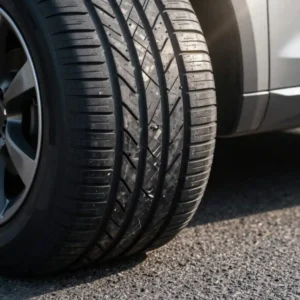
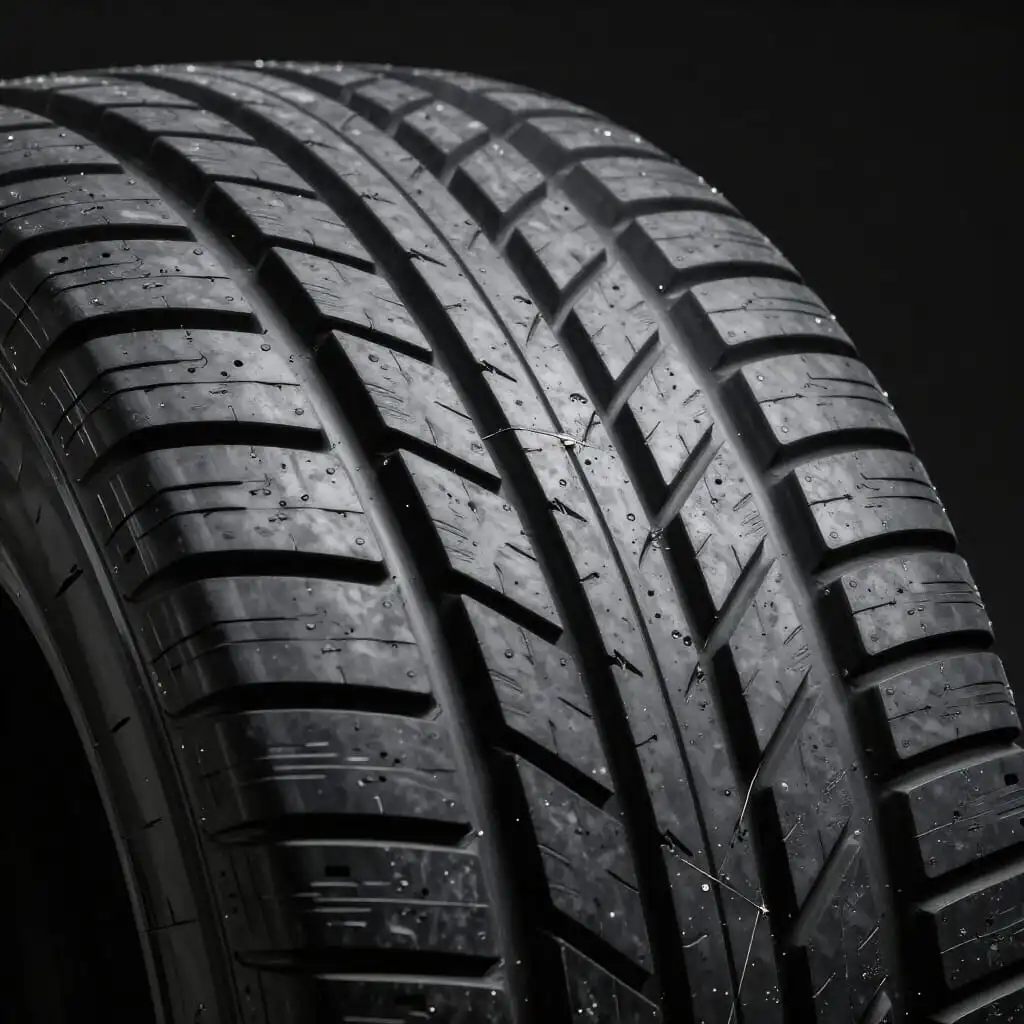
Tire tread consists of the grooves and rubber blocks that make up the tread surface—the part of the tire in direct contact with the road. It serves a dual purpose: evacuating water to prevent aquaplaning and providing mechanical grip on dry, wet, or snowy roads. Without tread, a tire would be like a racing “slick”—high-performance on a dry track but extremely dangerous as soon as it rains.
There are three main families of tire tread patterns. Symmetric tread features the same pattern on both halves of the tire; it can be mounted in any direction and is the most common and versatile option. Asymmetric tread combines different patterns on the inner and outer sides: rigid blocks on the outside for cornering stability, and finer grooves on the inside for water evacuation. Directional tread, often in a V or arrow shape, is designed to rotate in only one direction and excels on wet roads due to optimized water evacuation toward the outside.
The choice between these patterns depends largely on usage: a vehicle driven frequently on wet highways will benefit from a directional tread, while a mix of city and road driving is perfectly suited to a classic symmetric tread.
Tire Profile: Understanding Sidewall Height
The tire profile is indicated immediately after the width in the tire markings—for example, “205/55 R16.” In this case, 55 means that the sidewall height represents 55% of the tire’s width (205 mm). The lower this number, the “lower” the profile and the thinner the sidewall.
A low profile (40, 35, or even lower) offers better lateral stiffness, resulting in more precise handling in corners, but at the cost of reduced comfort since the sidewall absorbs fewer road irregularities. A high profile (60, 65, 70) prioritizes comfort and does a better job of cushioning potholes, but reacts less quickly to steering inputs.
The tire profile isn’t just about comfort; it also influences rim protection. A low profile exposes the rim more to impacts from curbs or potholes because there is less rubber to absorb the shock. This is why vehicles equipped with large rims and very low profiles require more attentive driving on degraded roads. You should never modify a tire’s profile from the manufacturer’s recommendations without checking compatibility, as it can affect speedometer accuracy and alter handling characteristics.
Tread Depth: Legal Limits and Wear Indicators
Tire tread depth is measured in millimeters at the bottom of the main grooves. A new tire generally has a depth between 7 and 8 mm, depending on the model and manufacturer. As you drive, the rubber wears down and this depth progressively decreases.
The law sets a strict minimum threshold: 1.6 mm. Below this level, the tire is considered illegal and dangerous, regardless of the season. To avoid having to use a gauge during every inspection, manufacturers integrate tread wear indicators (TWI) directly into the grooves: small raised bumps located at the bottom of the tread that become flush with the surface when the tread reaches 1.6 mm. When the indicator is visible at the same level as the surrounding rubber, it is a signal that the tire must be replaced immediately.
In practice, many professionals recommend anticipating this legal limit. Beyond mere legality, effectiveness on wet roads drops significantly well before reaching 1.6 mm. A simple method that requires no tools is to insert a coin into the main groove: if the outer rim of the coin disappears completely, the tread is still sufficient; if it remains visible, replacement is needed soon.
Winter Tire Tread: Designed for Cold and Snow
Winter tires do more than just use a softer rubber compound at low temperatures; their tread pattern is specifically engineered for snow and ice. They feature a dense network of sipes (small zigzag slits in the rubber blocks) that multiply the gripping edges on snowy ground, acting almost like microscopic claws.
The recommended tread depth for a winter tire is generally higher than for a summer tire because deep grooves allow for the storage of compacted snow, which actually grips better on existing snow than rubber alone. This is why it is advisable to change winter tires before they reach the legal 1.6 mm limit: below approximately 4 mm, performance on snow degrades sharply, even if the tire is still technically legal.
The profile of winter tires generally remains close to that of equivalent summer tires for the same vehicle, but some manufacturers offer slightly higher profiles on winter versions to improve comfort and limit the risk of punctures on degraded roads in winter conditions.
Motorcycle Tire Tread: Specific Cornering Constraints
On a motorcycle, the tire tread must contend with a constraint that cars don’t face: cornering lean angle. Unlike a car that rolls flat, a motorcycle leans heavily into curves, shifting the tire’s contact patch from the center toward the sidewalls.
This is why motorcycle tread patterns vary significantly between the center of the tread—which is denser and sometimes almost smooth to maximize the contact patch in a straight line and limit rapid wear—and the tire shoulders, where the pattern becomes more intricate to ensure grip at full lean. The motorcycle tire profile also plays a different role: it directly affects steering geometry and how easily the bike leans; a more rounded profile facilitates rapid angle changes.
The legal minimum depth remains the same as for cars, 1.6 mm, but wear on motorcycles is often asymmetrical: the shoulders wear faster than the center for riders who do a lot of cornering, while the center wears faster for highway cruising. It is therefore recommended to check motorcycle tire tread in several places around the tread, not just in the center.
What is the difference between tire tread and profile?
Tread is the raised pattern on the contact surface that ensures grip and water evacuation. Profile is the sidewall height expressed as a percentage of the tire’s width; it influences comfort and handling precision.
What is the legal minimum tread depth for a tire?
The legal minimum depth is 1.6 mm, measured using the tread wear indicators built into the tread grooves.
What is the tread depth of a new tire?
A new tire generally has a tread depth between 7 and 8 mm, depending on the model and manufacturer.
When should I change a winter tire based on its tread?
It is recommended to replace winter tires before they reach approximately 4 mm, as their effectiveness on snow decreases significantly well before reaching the legal 1.6 mm limit.
Does motorcycle tire tread wear evenly all over?
No, wear is often asymmetrical: the center wears more during highway use, while the shoulders wear faster for riders who lean heavily into corners.
Is it safe to change a tire’s profile?
Modifying the profile recommended by the manufacturer can cause speedometer errors and alter handling; it is best to stick to the original manufacturer specifications.
Sources
- Tire tread: role, regulations, and inspection – Vroomly
- Tire tread patterns – Ornikar
- Tire depth: at what threshold should you replace them? – Pièces et Pneus
- Comparison: what is the best tire tread pattern – Tiregom

À découvrir
Different Tire Types: Complete Car, Moto & Bike Guide
Discover the 5 main car tire types (summer, winter, all-season, sport, off-road) and their features. A complete guide to speed and load ratings.

Understanding Tire Dimensions: A Complete Guide
October 22, 2026
Tire Evolution: From Inner Tubes to Smart Tires
October 29, 2026