M+S Tire Markings: Meaning, Winter Laws, and Real Limits
- M+S stands for “Mud and Snow”: a manufacturer’s self-declaration, without mandatory certification testing.
- An M+S tire alone is no longer sufficient in areas covered by the Mountain Law (winter tire mandates) as of November 2024: the 3PMSF (snowflake) symbol is required.
- M+S tires remain tolerated until 2026 for tires purchased before that date, under specific transitional conditions.
- An M+S tire is not a certified winter tire: it indicates general capability for mud and light snow, not performance on black ice.
- The marking is read directly on the tire sidewall, often alongside other symbols like 3PMSF or “Ice Grip.”
The M+S marking on a tire stands for “Mud and Snow.” It indicates that the tire features a tread pattern, structure, or rubber compound designed to provide better traction than standard tires on soft, muddy, or lightly snow-covered ground. Contrary to popular belief, this marking does not guarantee any tested performance: it is based on a simple manufacturer declaration without mandatory independent certification. This is the fundamental difference with the 3PMSF symbol (the snowflake inside a three-peak mountain), which results from a regulatory snow grip test. For compliance with the Mountain Law in France, this nuance is critical: since November 2024, a tire simply marked M+S is no longer sufficient in most cases.
What exactly is M+S?
The acronym M+S — sometimes written as M.S, M&S, or M/S depending on the manufacturer — comes from the English “Mud and Snow.” Historically, this marking appeared in the United States in the 1970s to distinguish so-called “all-terrain” or “all-season” tires from purely road-oriented (summer) tires.
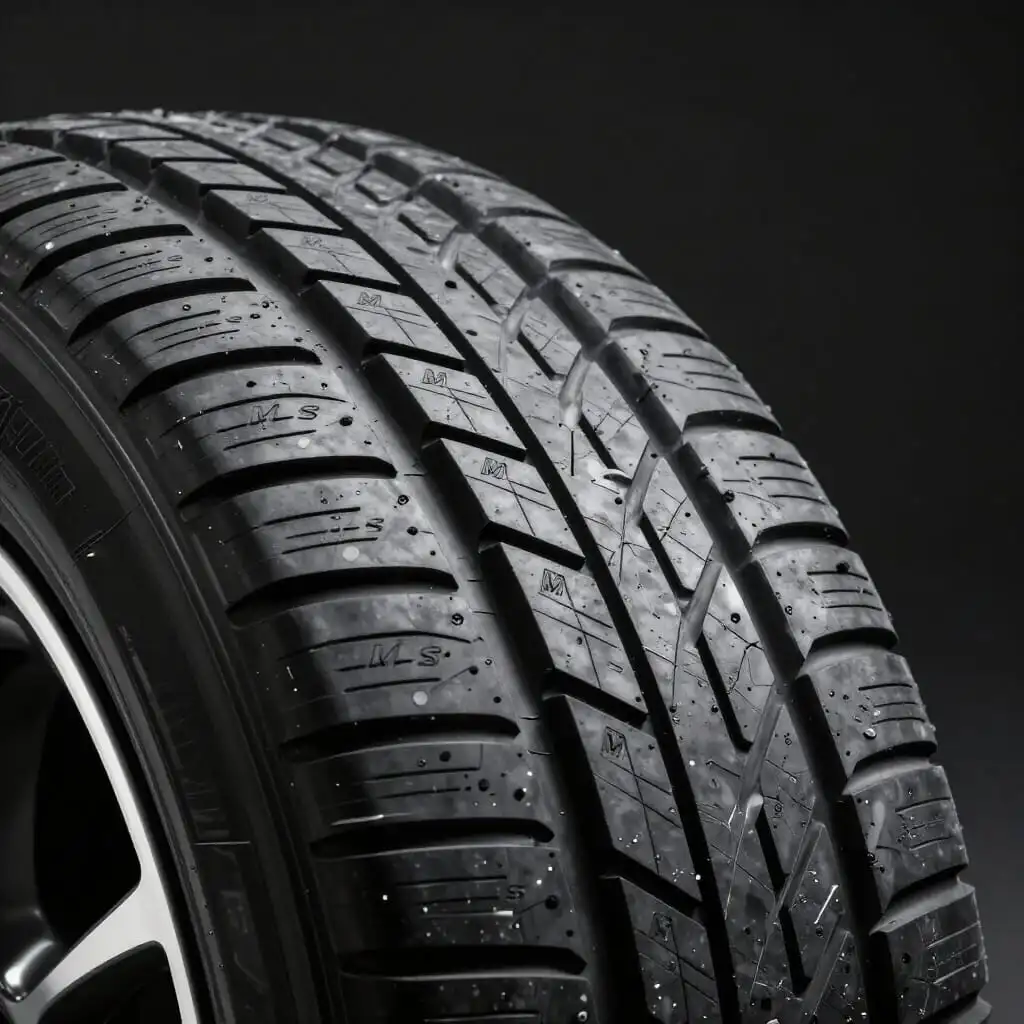
In practical terms, an M+S tire is recognizable by a more open tread pattern, with wider block spacing and more numerous sipes (small slits) than a standard summer tire. This design improves mud evacuation and grip on fresh, loose snow. You will find this marking on all-season tires, some older winter tires, and even all-terrain tires for SUVs and 4x4s.
The essential point to remember: no independent body verifies that the tire actually delivers on this promise. Unlike the 3PMSF symbol, which requires passing a snow braking test according to specific standards (such as ASTM or ISO), M+S is a manufacturer self-declaration based solely on geometric tread criteria (at least 25% block surface area with a minimum void ratio). Consequently, two different M+S tires can offer very different winter performance depending on the brand and product range.
M+S vs. 3PMSF: Don’t confuse the two
This is the most frequent confusion among drivers and motorcyclists: believing that an M+S tire is automatically a “real” winter tire. This is not the case.
The 3PMSF (Three Peak Mountain Snowflake), recognizable by the pictogram of a snowflake inside a three-peaked mountain, certifies that the tire has passed a packed snow grip test, demonstrating braking performance at least 10% better than a reference tire. This is the marking that attests to true winter capability.
A tire may display: – M+S only: tread pattern adapted for mud and light snow, but without performance testing. – 3PMSF only: theoretically possible, but rare. – Both M+S and 3PMSF: the most common case for modern winter and all-season tires, meeting both criteria.
For demanding winter driving (mountains, frequent black ice, high altitude), the decisive factor remains the 3PMSF, not the M+S. An M+S all-season tire without the snowflake may suffice for urban driving with occasional snow, but it will quickly reach its limits on mountain roads or in extreme cold, where the rubber hardens and loses grip.
M+S and Winter Laws: What has changed
The Mountain Law (winter tire mandate), which has been phased in since November 2021 and strengthened in November 2024, requires the use of winter tires or snow chains in 34 French departments between November 1st and March 31st (dates may vary based on local prefectural decrees).
The key point regarding this marking: since the 2024-2025 season, a tire marked only with M+S is no longer sufficient to meet the legal requirement in mountain zones. Only the following are now recognized as compliant: – Tires bearing the 3PMSF marking (with or without the associated M+S). – Or the use of snow chains/socks to supplement non-winter tires.
However, a transitional tolerance period exists: M+S tires (without 3PMSF) purchased before November 1, 2024, remain accepted until November 1, 2026, provided they were manufactured before 2024. After this date, only the snowflake symbol is valid wherever the Mountain Law applies.
In practical terms, if you drive regularly in the Alps, the Pyrenees, the Massif Central, or the Jura during winter, check your tire sidewalls: the M+S mention alone, without the 3PMSF snowflake, will no longer make you compliant after this deadline, even if the tire looks to be in good condition.
Are M+S tires banned?
No, an M+S tire is not banned per se—it remains perfectly legal to fit and use year-round, including outside the periods and zones covered by the Mountain Law. The confusion arises because some drivers believe that an M+S tire is automatically rejected outside of the winter season; this is also not the case, as they are not studded tires or equipment subject to strict seasonal restrictions like studded tires.
The only time M+S becomes problematic is within the legal framework of Mountain Law compliance after the aforementioned tolerance period ends. Outside of this specific framework—meaning for everyday use in plains or in areas not listed under the Mountain Law—an M+S tire remains a valid choice, particularly as an all-season tire intended for light summer/winter mixed use.
However, be aware of another often-ignored point: an M+S tire can lose its “mud and snow” capability before it loses its theoretical legality. The legal minimum tread depth is 1.6 mm for all tires, but for real winter effectiveness, professionals recommend replacing them as soon as the depth falls below 4 mm. Below this threshold, snow and mud evacuation becomes significantly less efficient, regardless of the marking on the sidewall.
Where to find the marking on the tire?
The M+S marking is found directly on the tire sidewall, usually embossed near the size dimensions (for example, 205/55 R16) or near the load and speed index. It may appear alone or accompanied by other pictograms:
- The 3PMSF symbol (snowflake in a mountain).
- The “Ice Grip” mention, specific to certain manufacturers to indicate a rubber compound optimized for black ice.
- The “All Season” or “4 Seasons” mention, which often accompanies the M+S on versatile tires.
If you are in doubt during a roadside check or before a trip to the mountains, it is better to physically check the sidewall rather than relying on the seller’s product sheet; some commercial references can cause confusion between “winter” ranges and “all-season M+S” ranges without the snowflake. A few seconds of visual inspection can prevent a fine or, worse, an unexpected loss of grip on a snowy road.
What exactly is an M+S tire?
M+S stands for “Mud and Snow.” It is a marking indicating that a tire has a tread pattern adapted for mud and light snow, without mandatory performance certification.
Is an M+S tire valid as an all-season tire?
Yes, most all-season tires carry the M+S marking, but not all M+S tires are necessarily full all-season tires: some are summer or all-terrain tires adapted only for mud.
Is the M+S marking sufficient for the Mountain Law?
No, since November 2024, M+S alone is no longer sufficient in Mountain Law zones: the 3PMSF symbol is required, except during the transitional tolerance period for tires purchased before that date.
Is an M+S tire without 3PMSF banned?
No, it remains legal for general use. It only becomes non-compliant within the specific framework of the Mountain Law once the tolerance period has expired.
How can I tell if my tire has the M+S marking?
Look at the tire sidewall near the size indications: the M+S mention (or M.S, M&S) is embossed there, sometimes accompanied by the 3PMSF symbol.
What is the difference between M+S and 3PMSF?
M+S is a manufacturer’s self-declaration based on tread design. 3PMSF results from a regulated snow braking test, guaranteeing actual winter performance.
Sources
- What does M+S on a tire mean? — MD Auto
- What is a 3PMSF or M+S tire — Allopneus
- M+S and 3PMSF: what do these markings mean — La Voiture
- Explanation of tire markings — Michelin
- 3PMSF and M+S symbols — Norauto

À découvrir

How Are Tires Tested? Complete Methodology
Learn how tires are tested for safety, performance, and wear. Expert explanation of tire testing methodologies.
All-Season Tires: How They Work & Key Features
October 26, 2026
Radial Tire: Definition, How It Works & Benefits
October 31, 2026